Responsible AI Framework: The Governance Pillar Every Enterprise Needs
Responsible AI requires infrastructure, not just principles. Here's why governance is the most critical pillar and how enterprises can operationalise it.

On this page›
- What Responsible AI Means for the Enterprise
- Why Responsible AI Matters
- How WalledAI Helps Teams Govern AI
- Four Pillars of Responsible AI
- Platform Mapping: Products to Pillars
- Why Governance Is the Most Critical Pillar
- Building Your Responsible AI Framework
- Responsible AI Meets Global Regulation
- Frequently Asked Questions
Responsible AI is more than fair algorithms and ethical training data. It requires an infrastructure layer that governs how AI is used across your enterprise - ensuring every interaction meets standards for reliability, safety, privacy, and security.
WalledAI is that infrastructure layer.
What Responsible AI Means for the Enterprise
Responsible AI is the disciplined practice of designing, deploying, and operating AI systems in a way that is safe, explainable, privacy-conscious, and accountable. It turns principles such as fairness and transparency into controls that teams can apply to real prompts, documents, models, and automated decisions. The goal is not to slow innovation; it is to make useful AI dependable enough for customers, employees, regulators, and business leaders to trust.
WalledAI's governance approach aligns with the NIST AI Risk Management Framework, which helps organizations govern, map, measure, and manage AI risk.
Why Responsible AI Matters
Enterprise AI can expose confidential information, amplify inaccurate content, or make unsafe recommendations in seconds. Responsible AI governance gives security, compliance, product, and engineering teams a shared operating model for identifying these risks and responding before they become incidents. It also creates evidence of how policies were applied, which helps organisations demonstrate accountable AI practices across regions and regulated industries.
For generative AI-specific risk guidance, see NIST's Generative AI Profile.
How WalledAI Helps Teams Govern AI
WalledAI places governance controls between your users, applications, and large language models. Walled Redact masks sensitive data before it reaches an external model and restores the response in context. Walled Protect detects prompt injection, harmful content, and policy violations. Walled Correct checks outputs against trusted sources, while governance capabilities apply role-based access, classification, and audit trails. These controls support on-premise, private cloud, and air-gapped deployments, so teams can improve AI safety without giving up data sovereignty.
Four Pillars of Responsible AI
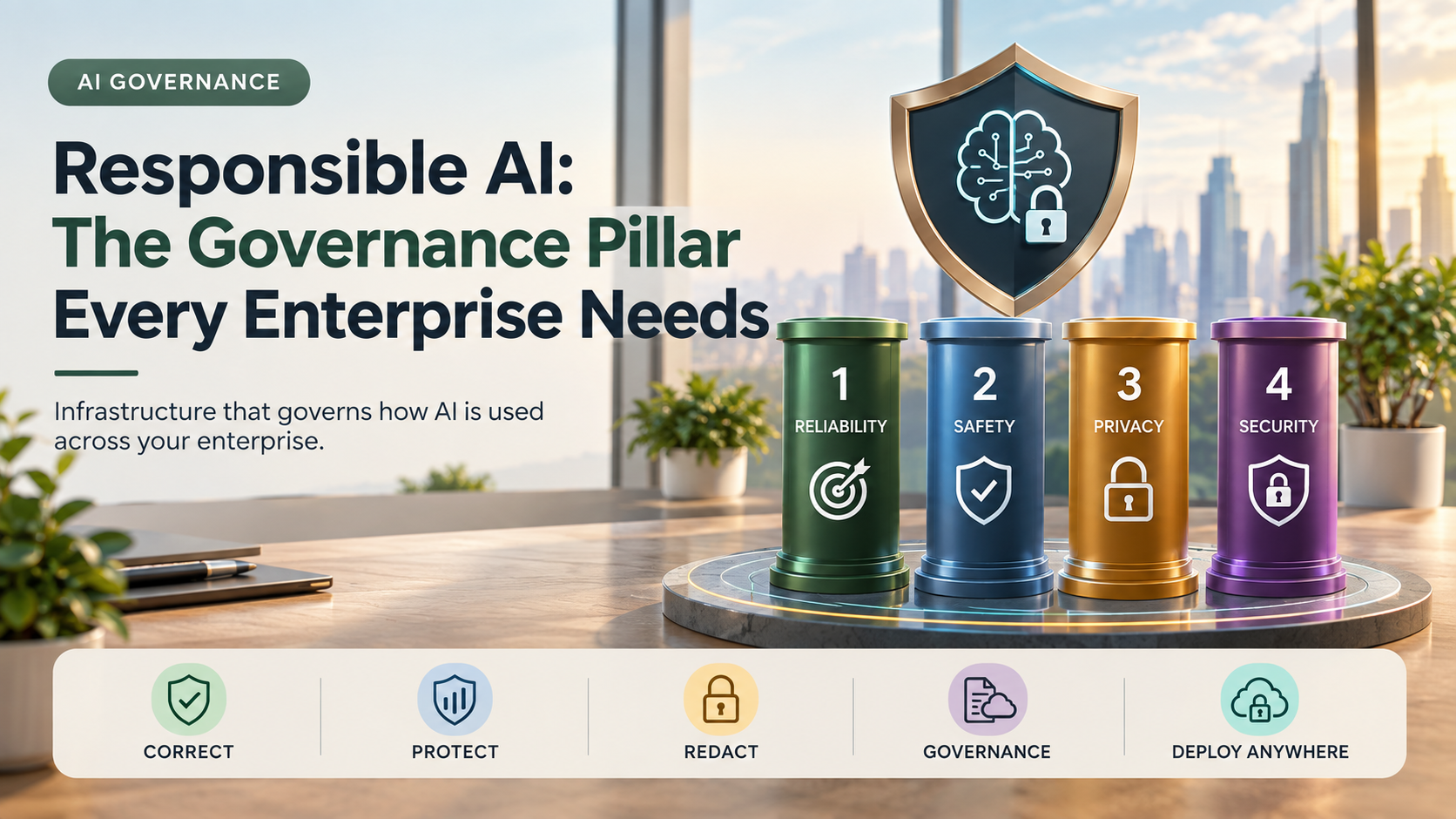
Each pillar of AI governance is addressed by purpose-built capabilities within the WalledAI platform.
1. Reliability
AI systems must produce accurate, consistent, and verifiable outputs. In regulated industries, a hallucinated citation, fabricated statistic, or wrong product detail isn't just embarrassing - it's a liability.
WalledAI's solution: Walled Correct validates every AI response against ground truth before delivery, with configurable confidence thresholds, citation verification, and automatic escalation to human review when confidence falls below threshold.
2. Safety
AI interactions must be free from harmful, toxic, or manipulative content. As agentic AI scales, safety guardrails must extend beyond simple chat to multi-step workflows where agents autonomously interact with LLMs.
WalledAI's solution: Walled Protect provides real-time content filtering, prompt injection detection and blocking, off-topic query enforcement, and custom policy rules for industry-specific compliance requirements.
These controls address risks outlined in the OWASP Top 10 for LLM Applications, including prompt injection and insecure output handling.
3. Privacy
Sensitive data - PII, PHI, trade secrets, financial records - must never reach external LLM providers. Privacy isn't just about compliance; it's about maintaining the trust your customers, patients, and partners place in you.
WalledAI's solution: Walled Redact provides multi-modal data masking across text, images, documents, code, and audio, with automatic detection, replacement with synthetic placeholders, seamless unmasking on response return, and on-premise/air-gapped deployment for maximum sovereignty.
4. Security
Every AI interaction must be governed, auditable, and controlled. Security in AI governance means knowing who used what model, with what data, and what policies were applied - across every interaction.
WalledAI's solution: Granular role-based access control (RBAC) per team and use case, automated data classification with sensitivity tagging, governance dashboard with custom risk policy upload, and full audit trail of every AI interaction for regulatory evidence.
WalledAI's threat-aware governance model also reflects adversarial AI techniques documented in MITRE ATLAS. Controls are enforced through automated data classification and role-based access control.
Platform Mapping: Products to Pillars
| Product | Reliability | Safety | Privacy | Security |
|---|---|---|---|---|
| Walled Redact | ✓ | ✓ | ||
| Walled Protect | ✓ | |||
| Walled Correct | ✓ | |||
| Data Classification | ✓ | ✓ | ||
| Enterprise RBAC | ✓ | |||
| Governance Dashboard | ✓ | ✓ | ||
| Shadow AI Detection | ✓ |
Why Governance Is the Most Critical Pillar
You can build the fairest, most ethical AI model in the world - but if your employees paste client data into ChatGPT, if your agents send trade secrets to external APIs, if your organisation can't evidence how AI is being used - none of it matters.
Governance is where Responsible AI meets the real world. It's the infrastructure that ensures your AI policies aren't just written in a PDF somewhere - they're enforced at every interaction, across every team, in real time.
This practical approach supports the accountability, transparency, and robustness principles in the OECD AI Principles, and is evidenced through our governance dashboard and audit trails.
Building Your Responsible AI Framework
A practical Responsible AI framework doesn't start with philosophy. It starts with infrastructure:
- Inventory your AI systems. Know what models you're running, where they're hosted, and what data they access.
- Classify your data. Tag sensitivity levels on inputs so you can apply the right controls - masking for external models, blocking for internal use only.
- Enforce controls at the infrastructure layer. Don't rely on policy alone; embed rules in your AI platform so they apply consistently across every team.
- Validate outputs before delivery. Check AI responses for accuracy, harmful content, and unintended data leakage.
- Log everything. Build an audit trail so you can evidence compliance, investigate incidents, and demonstrate due diligence to regulators.
- Review and adapt. Regular red-team exercises, user feedback, and regulatory updates should drive continuous improvement.
Responsible AI Meets Global Regulation
Whether it's the EU AI Act, Singapore's PDPA, or NIST guidance, the frameworks all converge on the same core: responsible organisations must govern their AI use, log their governance decisions, and be prepared to evidence them. WalledAI's approach operationalizes these requirements without requiring organizations to build compliant AI infrastructure from scratch.
Frequently Asked Questions
What is WalledAI's approach to Responsible AI?
We believe responsible AI is an infrastructure challenge, not a philosophy challenge. Our platform places governance controls - data masking, output validation, access control, and audit logging - between your teams and AI models, ensuring every interaction is safe, compliant, and auditable.
How does WalledAI prevent AI hallucinations?
Walled Correct validates AI responses against your ground truth - customer records, product specifications, internal documentation - before they reach end users. When confidence falls below your threshold, the response is escalated for human review rather than delivered with hallucinated information intact.
How can an enterprise put Responsible AI into practice?
Start with an AI system inventory, classify your most sensitive data, deploy masking controls on cross-border transfers, add output validation for high-stakes decisions, and build an audit trail. Each step produces compliance evidence; each layer reduces risk. The order matters - start with inventory and masking, then add validation and oversight.
Does governance slow down AI adoption?
No - governance accelerates adoption by building trust. When your teams, customers, and regulators know AI is governed, auditable, and safe, they're more willing to deploy it. The real slowdown comes from trying to adopt AI without governance, then being forced to rip out deployments when a compliance gap is discovered.
How is Responsible AI different from ethical AI?
Ethical AI is about principles - fairness, transparency, accountability. Responsible AI adds infrastructure - controls that enforce those principles at runtime, evidence that the controls worked, and audit trails that prove it. Responsible AI is ethical AI made operational.
Ready to operationalise Responsible AI across your enterprise? Get in touch with our team to see how WalledAI's governance infrastructure can support your responsible AI journey across reliability, safety, privacy, and security.
Get audit-ready before August 2026.
See how WalledAI operationalises Articles 9–15 and Article 50 obligations as a runtime governance layer.