
Data Loss Prevention
Built for AI
Your DLP has never read a prompt. Your people write hundreds a day!
Every day, your people paste client records, contracts and source code into third-party AI. WalledAI stands in the way. It deep scans every prompt, file and API call before it leaves your endpoints - so the work keeps moving, and your data never does.
Live demo in under 24 hours · No commitment required
- SOC 2 Type II
- ISO 27001
- GDPR
- PDPA
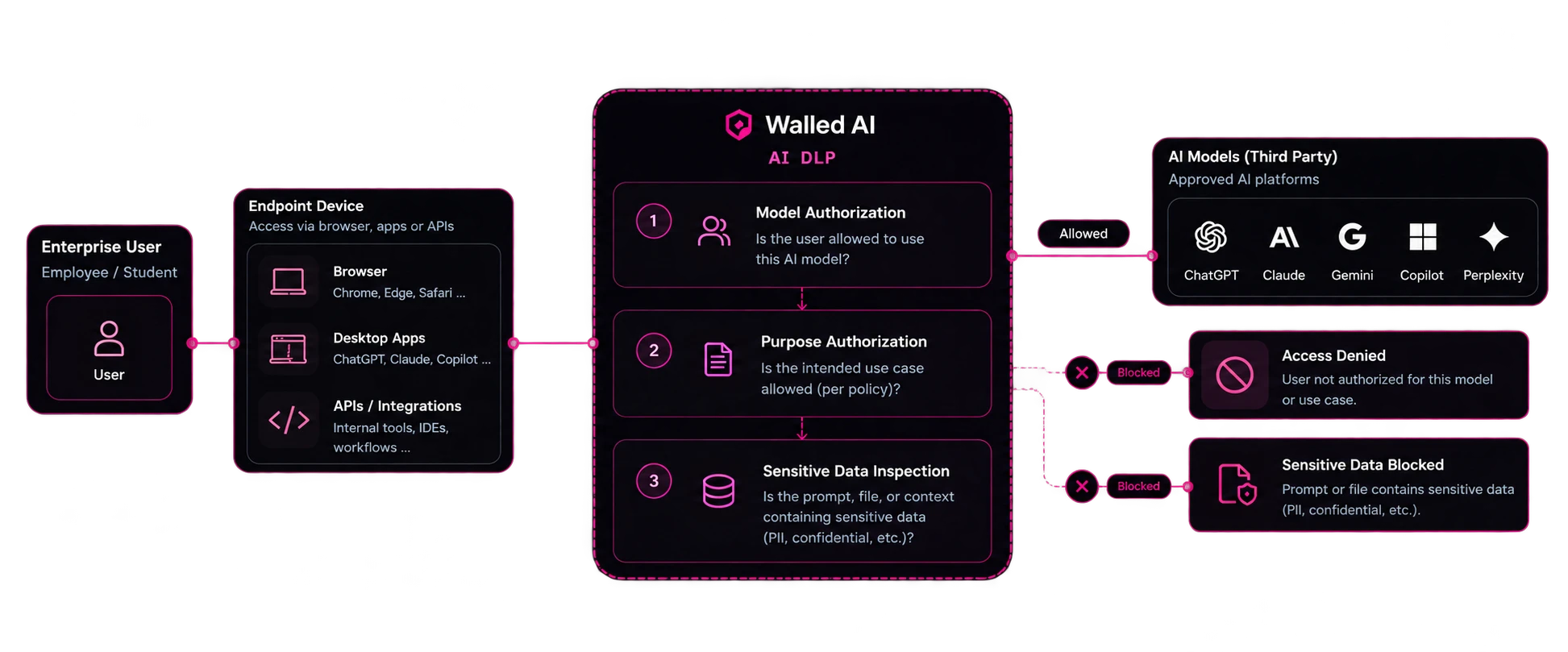
Model authorization, purpose authorization, and sensitive data inspection - inline, before the request reaches any model.
Trusted By




Who Gets Governed
Everyone who touches AI - not just one team
AI isn't confined to one function any more. Sales, finance, HR, legal, support, engineering and the executive team all use it daily, and each of them reaches for it with exactly the material that shouldn't leave: the client record, the salary band, the unsigned contract, the customer ticket, the private repository. It happens dozens of times a day, in good faith, by people doing their jobs. WalledAI governs all of them under one policy set.
Sales & marketing
Drafting outreach, summarising calls, building proposals - with named customers, pipeline values, and unannounced pricing in the prompt.
Finance
Modelling, variance analysis, board packs - pasting unreleased results, account numbers, and counterparty terms.
HR & people
Job descriptions, review summaries, policy drafts - carrying employee names, salary bands, and performance records.
Legal & compliance
Contract review, clause comparison, regulatory research - on unsigned agreements, counterparty names, and privileged material.
Customer support
Summarising tickets and drafting replies - with the customer's identity, address, and account history attached.
Software engineers
Coding assistants, IDE plugins, agents, direct API calls - sending private source, credentials, config, and production data.
Different people, different tools, different use cases - one control plane, one policy set, and one audit trail across all of them.
Where The Data Leaves From
Every endpoint, every route to a third-party AI
Coverage is what separates state-of-the-art AI DLP from a blocklist. An employee who can't reach a model in the browser will open the desktop app; an integration that bypasses both will call the API directly. WalledAI governs all three surfaces under one policy, so there is no route out that is quietly cheaper than the governed one.
Browser
Chrome, Edge, Safari and any AI web app opened in them - including sessions signed in with a personal account that never appears in a corporate SSO log.
Desktop apps
ChatGPT, Claude, Copilot and other native AI clients that run outside the browser entirely, where a web proxy or domain blocklist sees nothing useful.
APIs & integrations
Internal tools, IDEs, notebooks, automated workflows, and agents that call a model directly - governed at the gateway rather than tool by tool.
AI tools nobody registered are a separate problem - Shadow AI Detection is what finds them.
Why Your Existing DLP Can't Close This
Traditional DLP does not solve AI data exposure
Legacy data loss prevention makes one coarse decision at the perimeter: let the destination through, or shut it down. Where it inspects at all, it is shallow - a pattern match against known formats in a known file type, not an understanding of what the content means. Point it at AI and it has nothing to work with: the payload is free text typed into a browser, a file dropped into a desktop app, or an API call from an internal tool. So it does the only thing it knows how to do - ban the tool outright, or wave every prompt through unexamined. Neither is governance, and no amount of tuning turns one into the other.
Blunt: ban the tool, or allow everything
Its only lever at the AI boundary is the whole destination. Block ChatGPT for the entire company, or let every prompt through unexamined. Blanket bans just move the work to a personal laptop.
Shallow: patterns, not meaning
Where it does inspect, it matches known formats inside known file types. It doesn't read what a paragraph is actually disclosing, so anything unformatted walks straight past.
Pasted text isn't a file
A customer list pasted into a chat box never becomes an attachment, so inspection built around files never fires at all.
Blind past the browser
Desktop AI apps run outside the web proxy and internal tools call model APIs directly. Neither shows up as a file leaving an endpoint.
It doesn't know who, or why
A domain-level control sees a connection to an AI service. It can't tell whether that user is authorized for that model, or cleared for that use case.
No record of what was sent
When an auditor asks which records reached which model, a firewall log shows a destination - not the entities inside the prompt.
AI exposure needs a control built for AI. WalledAI is the state of the art: the enforcement layer that stands between your endpoints and every third-party AI, deciding who may use which model, for which purpose, and what may travel in the payload - after a deep scan of the prompt, the document, the image, the code, and the context. It runs inside your own boundary, at under 30ms, with evidence for every decision. This is the layer legacy DLP was never built to cover, and the one AI adoption now depends on.
How AI DLP Works
Three checks between your people and any AI model
WalledAI sits between the endpoint and the model provider. Every request passes the same three checks in the same order, and the order matters: identity and purpose are settled before anything is inspected, so a request that was never permitted is stopped before its payload travels anywhere.
Model Authorization
Is this user allowed to use this AI model?
The first question isn't what's in the prompt - it's whether this person should be talking to this model at all. Entitlements come from your identity provider and org structure, so a contractor, an analyst, and a CFO don't share the same set of approved platforms.
- Per-user and per-group model entitlements
- Corporate accounts distinguished from personal ones
- Sanctioned platforms only - everything else is unsanctioned by default
Purpose Authorization
Is the intended use case allowed under policy?
Access to a model is not blanket permission to use it for anything. The same employee on the same platform can be cleared to draft marketing copy and barred from running candidate screening or credit decisions, because policy is written against the use case, not just the tool.
- Use-case policies per department and role
- High-risk purposes gated or escalated for review
- Policy version recorded with every decision
Sensitive Data Inspection
Does the prompt, file, or context carry sensitive data?
Only once the user and the purpose clear does WalledAI deep scan the payload itself. Not a pattern match on a file extension - it opens the document, reads the text inside the screenshot, parses the code, and works on meaning in context, so an unformatted customer list in the middle of a paragraph is caught as surely as a card number.
- Deep content inspection across 15+ modalities, not file types
- PII, PHI, financial identifiers, secrets, source code, and IP
- Context-aware: catches what no regex has a pattern for
Three checks, three outcomes
Every request resolves to one of three dispositions, and every one of them - including the allows - is written to the audit log with the user, the destination, the policy version, and what was found.
Allowed
User, purpose, and payload all clear. The request reaches the approved platform - ChatGPT, Claude, Gemini, Copilot, Perplexity - and the interaction is logged.
Access Denied
The user isn't authorized for this model, or the use case isn't permitted under policy. The request stops at the first or second check, before any payload is transmitted.
Sensitive Data Blocked
The user and purpose were fine, but the prompt or file carried sensitive data. The interaction is stopped - or, where policy allows, the sensitive values are masked and the work continues.
When check 3 fires, blocking isn't the only answer
Some data genuinely can't leave, and the block stands. But for most interactions the model needs the structure of the request, not the real customer name or the real deal value. Where your policy allows it, Walled Redact masks the sensitive values instead - the employee's work continues, and nothing sensitive crosses the boundary.
What check 3 catches
"Summarise the renewal risk for Meredith Chan at Northwind Logistics, contract #NW-2291, ARR $4.1M, renewal 14 March."
Five sensitive entities in one prompt. Under a block policy, the request stops here.
What reaches the model instead
"Summarise the renewal risk for [PERSON_1] at [ORG_1], contract [ID_1], ARR [AMOUNT_1], renewal [DATE_1]."
The model answers on structure. Real values are restored only in what the employee sees - and the whole exchange is logged.

Prevention only counts if it happens before the endpoint reaches a third-party AI.
Legacy DLP vs AI DLP
Same category name, different problem. Here is what changes when the control is designed for the AI boundary instead of retrofitted to it.
| Dimension | Legacy DLP | WalledAI AI DLP |
|---|---|---|
| Decision it can make | Ban the destination, or allow it | Allow, block, or mask - per request, not per tool |
| Depth of inspection | Pattern match on known file formats | Deep scan of prompts, documents, images, code, and context |
| Unit of inspection | Files and attachments leaving an endpoint | The payload of every AI request, in any format |
| Who may use which model | Not modelled at all | Model authorization per user, role, and account type |
| What it may be used for | Not modelled at all | Purpose authorization against your use-case policy |
| Endpoint coverage | Browser traffic, via domain lists | Browser, desktop apps, and APIs or integrations |
| Productivity impact | Bans push the work onto personal devices | Masking keeps the work flowing with the data removed |
| Evidence produced | Connection and file logs | Per-interaction record: entities, policy version, decision |
| Deployment boundary | Mostly vendor cloud | On-premise, private cloud, or fully air-gapped |
See what your people are actually sending to AI
A free 2-week pilot in your environment, ending with an audit-ready report of every request and entity detected.
What carries each check, component by component
AI DLP is an outcome, not a separate box to buy. Each check is carried by a component of the WalledAI platform, deployed together as one control plane with one policy set and one audit trail.
Enterprise RBAC
Holds the entitlements behind model and purpose authorization - which platforms each role may use, and for which use cases.
Data Classification
Tags what the payload actually contains and maps it to your sensitivity taxonomy, so inspection decisions stay consistent across every department.
Walled Redact
The alternative to blocking: masks the sensitive values so the model still gets usable context, then restores them in the response the employee sees.
Shadow AI Detection
Finds the AI tools, accounts, extensions, and agents that were never put through these checks in the first place.
Walled Protect
Guards the traffic that does get through - prompt injection, jailbreaks, and policy-violating content, on both the input and output path.
Governance Dashboard
Turns every allow and every block into an audit-grade record, exportable and mapped to the frameworks you report against.
Evidence a regulator will accept
A data-loss incident involving personal or regulated data is a reportable event, with clocks attached. AI DLP earns its place by producing the record that answers the questions asked afterwards - which user, which model, which use case, which entities, under which policy.
GDPR
Lawful processing and cross-border transfer of personal data submitted to a model.
Singapore PDPA
Consent, purpose limitation, and protection obligations across AI workflows.
HIPAA
PHI masked before it reaches a model, with access logging that stands up to review.
EU AI Act
Data governance and record-keeping duties under Articles 9-15 and Article 50.
MAS TRM
Technology risk controls and audit evidence for financial institutions.
NIST AI RMF
Govern, Map, Measure, and Manage applied at runtime rather than on paper.
- SOC 2 Type II
- ISO 27001
- GDPR
- PDPA
DLP that never ships your data to another vendor
A loss-prevention layer that streams your most sensitive content to a third-party cloud has moved the problem, not solved it. WalledAI runs inside your boundary - masking maps, prompts, and audit logs included.
On-premise
Runs in your data centre. Nothing - prompts, masking maps, or logs - leaves your infrastructure.
Private cloud
Deployed in your own VPC or sovereign cloud region, under your keys and your residency requirements.
Air-gapped
Fully disconnected operation for classified, defence, and government workloads.
Close the AI-shaped hole in your DLP
Deploy on-premise, in your private cloud, or fully air-gapped - and see every request your policy would have caught.
Frequently Asked Questions
What is AI DLP?
AI DLP is data loss prevention applied to AI interactions rather than files. Every request to a model passes three checks before it leaves: model authorization (is this user allowed to use this AI model), purpose authorization (is the intended use case permitted under policy), and sensitive data inspection (does the prompt, file, or context contain PII, confidential records, credentials, or proprietary content). The outcome of every check is logged.
Why doesn't traditional DLP cover AI usage?
Traditional DLP has one lever at the AI boundary - ban the destination or allow it - and where it inspects, it matches patterns inside known file formats rather than reading what the content means. An AI interaction gives it nothing to work with: free text typed into a browser, a file dropped into a desktop app, or an API call from an internal tool. Domain-level controls can see that traffic reached an AI service, but not whether that user was authorized for that model, whether the use case was permitted, or which entities were in the payload.
What is model authorization?
Model authorization is the first check: whether this specific user is entitled to use this specific AI model at all. Entitlements come from your identity provider and org structure, so a contractor, an analyst, and a CFO can each have a different set of approved platforms - and a personal account on an otherwise approved service can be treated differently from a managed corporate one.
What is purpose authorization, and why is it separate?
Access to a model is not blanket permission to use it for anything. Purpose authorization checks the intended use case against policy, so the same employee on the same platform can be cleared to draft marketing copy while being barred from candidate screening or credit decisions. Keeping it separate from model authorization is also what lets high-risk use cases be gated or escalated without banning the tool outright.
What happens when a request is blocked?
There are two block outcomes. Access Denied means the user was not authorized for that model, or the use case was not permitted - the request stops at check 1 or 2, before any payload is transmitted. Sensitive Data Blocked means the user and purpose were fine but the prompt or file carried sensitive data at check 3. Both are logged with the reason, the policy version, and the user.
Does AI DLP have to block, or can it protect the data instead?
Where your policy allows it, Walled Redact masks the sensitive values rather than stopping the request: the model receives the structure and context of the prompt with the real names, identifiers, and figures replaced by tokens, and the real values are restored only in the response the employee sees. Some data genuinely can't leave, and for that the block stands.
What kinds of data does the inspection check detect?
PII, PHI, financial identifiers such as account and card numbers, credentials and secrets, source code, contract terms and deal values, and customer or client identities - 50+ entity types across 15+ modalities. The scan is deep rather than format-based: it opens the document, reads the text inside a screenshot, parses code, and works on meaning in context, so an unformatted customer list inside a paragraph is caught as surely as a card number. Custom entity types cover anything specific to your business.
Which endpoints does AI DLP cover?
Browser sessions in Chrome, Edge, and Safari; native desktop AI clients such as ChatGPT, Claude, and Copilot that run outside the browser; and APIs or integrations - internal tools, IDEs, notebooks, automated workflows, and agents that call a model directly. All three surfaces run through the same three checks and the same policy.
How much latency does inline AI DLP add?
The three checks complete inline with under 30ms of overhead on a typical request, so enforcement happens before anything leaves your boundary without a noticeable delay for the user.
Does AI DLP work with any LLM?
Yes. WalledAI is model and vendor agnostic. The same policy applies whether the request goes to ChatGPT, Claude, Gemini, Copilot, Perplexity, Llama, Mistral, or a self-hosted model, because the checks run on the request path rather than inside the model.
Does AI DLP replace our existing DLP tool?
They answer different questions and run alongside each other. Legacy DLP makes a coarse decision about a destination - allow the channel or ban it - and inspects by matching patterns inside known file formats. AI DLP decides per request: whether this user may use this model, whether the use case is permitted, and what a deep scan of the payload finds in the prompt, document, image, code, or context. Both can feed the same SIEM and GRC workflows.
What audit evidence does AI DLP produce?
Every request is logged with the user and role, the AI model and account type, the use case, the entities detected, the policy version applied, and the outcome - allowed requests included, not just blocks. The Governance Dashboard exports this as evidence mapped to frameworks such as the EU AI Act, MAS TRM, NIST AI RMF, PDPA, HIPAA, and SOC 2.
Can AI DLP be deployed on-premise or air-gapped?
Yes. WalledAI deploys on-premise, in your private cloud, or fully air-gapped. Prompts, masking maps, and audit logs stay inside your boundary, which matters for a control whose whole purpose is preventing sensitive data from reaching third parties.