Data Security Protocols for AI: An Enterprise Playbook
Build enforceable AI data security across seven trust zones, with concrete controls, owners, evidence, and a 90-day rollout plan.

On this page›
- Why AI Data Security Requires a New Control Path
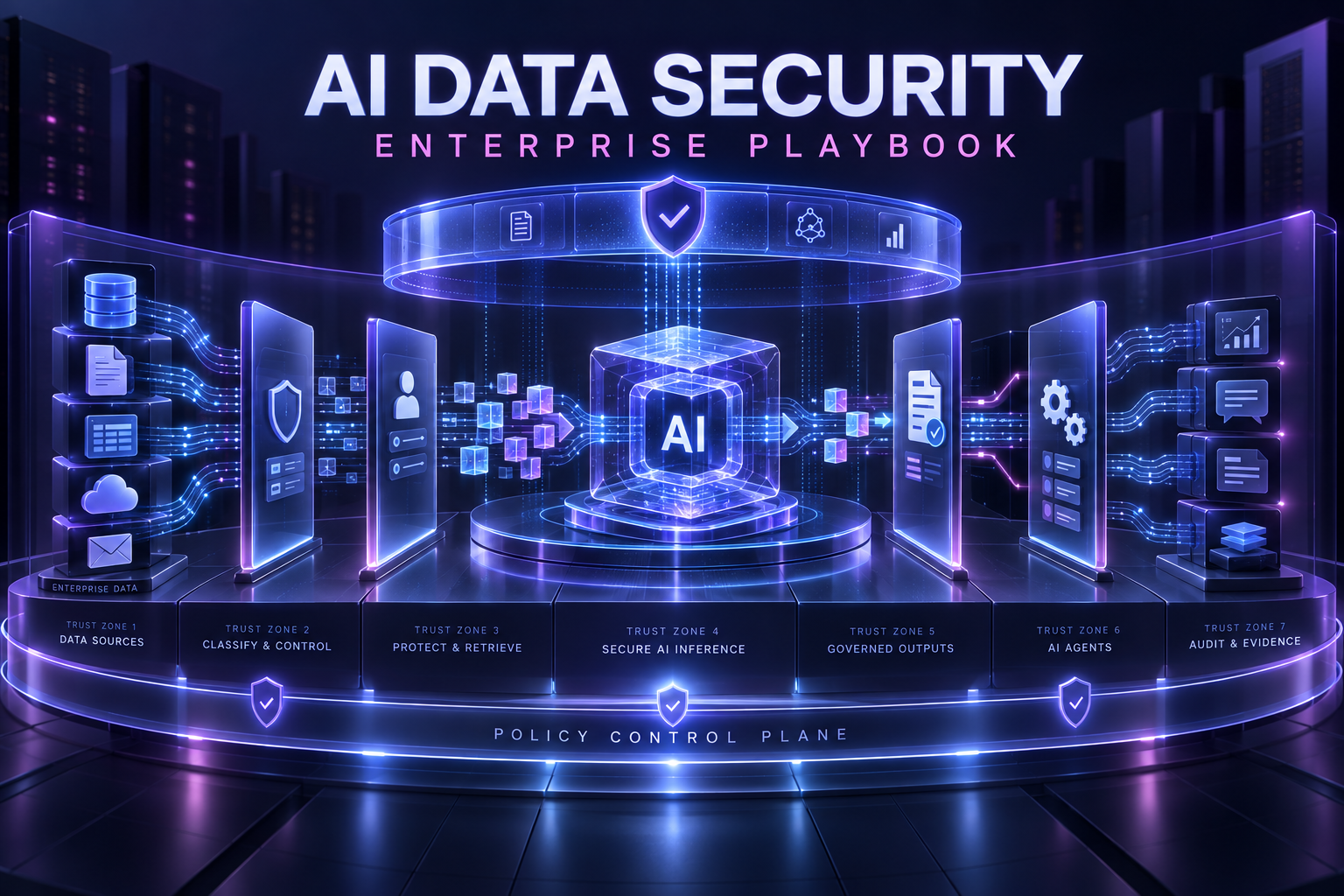
- The Seven Trust Zones of Enterprise AI Data Security
- Protocol 1: Inventory Every AI Data Flow
- Protocol 2: Classify and Minimize Before AI Processing
- Protocol 3: Make Identity the Control Plane
- Protocol 4: Secure Prompts, Files, and Retrieval
- Protocol 5: Protect Training, Fine-Tuning, and Evaluation Data
- Protocol 6: Control the Model and Provider Boundary
- Protocol 7: Validate Outputs Before They Become Actions
- Protocol 8: Build Audit Evidence Without Building a Data Lake of Prompts
- Protocol 9: Detect, Respond, and Recover
- Protocol 10: Test Controls and Measure Residual Risk
- A 30/60/90-Day AI Data Security Rollout
- AI Data Security RACI
- How WalledAI Helps Operationalize the Playbook
- Frequently Asked Questions
Last reviewed: 14 September 2026
Enterprise AI changes the path that sensitive data takes. A document can move from a repository into retrieval, through a prompt, into a hosted model, then into an agent action and an audit log in seconds. Traditional controls still matter, but they must be connected across that full path.
Quick answer: An effective AI data security protocol combines inventory and classification, data minimization, identity-aware access, protection before model transmission, retrieval authorization, training-data provenance, output and agent controls, and privacy-preserving audit evidence. Apply the controls at every trust boundary and test them continuously.
This playbook is for security, data, platform, privacy, and AI governance teams that need to turn policy into technical controls. It draws on the NIST Generative AI Profile, the joint NSA-led guidance on AI data security, the OWASP risks for LLM and generative AI applications, and the data governance and logging principles in the EU AI Act.
Why AI Data Security Requires a New Control Path
AI systems combine familiar assets in unfamiliar ways: unstructured documents, prompts, embeddings, model weights, tool credentials, generated content, and autonomous actions. The security objective is still confidentiality, integrity, and availability, but the attack surface now includes:
- Prompts and uploads that disclose personal data, intellectual property, secrets, or regulated records
- Retrieval pipelines that expose documents a user was never authorized to read
- Training and fine-tuning data that may be poisoned, mislabeled, duplicated, or used without a valid purpose
- Model and application outputs that reveal sensitive information or become unsafe instructions for downstream software
- Agents and tools that convert generated text into database writes, emails, purchases, or infrastructure changes
- Logs and evaluation datasets that quietly become a second store of raw prompts and confidential outputs
- Third-party providers whose retention, training, support access, subprocessors, and regional processing may differ by product tier
OWASP’s current generative AI risk work covers prompt injection, sensitive information disclosure, supply-chain weaknesses, data and model poisoning, improper output handling, and excessive agency. These risks show why a single DLP rule or vendor contract cannot secure the entire AI lifecycle.
The Seven Trust Zones of Enterprise AI Data Security
| Trust zone | Primary risk | Required control | Evidence |
|---|---|---|---|
| 1. Data sources | Unknown sensitivity, purpose, ownership, or provenance | Inventory, classification, lineage, approved-purpose tags | Data register and lineage record |
| 2. Identity and access | Over-broad human or machine access | SSO, least privilege, workload identity, short-lived credentials | Access policy and review history |
| 3. Prompt and retrieval | Sensitive inputs or unauthorized context reach a model | Minimization, masking, retrieval-time authorization, tenant isolation | Policy decision and protected request record |
| 4. Training and adaptation | Poisoned, unlicensed, altered, or untraceable datasets | Provenance, integrity verification, dataset approval, reproducible builds | Dataset card, signatures, and change history |
| 5. Model inference | Uncontrolled provider processing or model access | Approved routing, encryption, residency rules, endpoint isolation | Model route, contract, and configuration evidence |
| 6. Outputs and agents | Disclosure, injection propagation, or unauthorized action | Output validation, policy checks, scoped tools, human approval | Validation result and action authorization |
| 7. Telemetry and evidence | Logs leak data or cannot reconstruct decisions | Minimized logging, tamper resistance, access control, retention | Protected event trail and retention record |
The zones are connected. A perfect inference boundary cannot compensate for an over-permissioned retrieval index, and secure training data cannot prevent an agent from acting with an unrestricted service account.
Protocol 1: Inventory Every AI Data Flow
Start with flows, not vendors. Record where data originates, how it is transformed, which model receives it, where outputs go, and who can act on them. Include employee AI tools, embedded SaaS copilots, internal applications, APIs, IDE extensions, agents, MCP servers, batch jobs, evaluation systems, and fine-tuning pipelines.
For each flow, capture:
- Business purpose, owner, users, and approval status
- Input and output data classes
- Retrieval sources, vector stores, caches, and conversation memory
- Model provider, model version, region, deployment type, and account tier
- Retention, training-use, human-review, and deletion settings
- Connected tools, credentials, write permissions, and downstream systems
- Logging destinations, support access, and subprocessors
Continuous Shadow AI detection should feed this inventory because a questionnaire captures approved systems, not necessarily real use.
Protocol 2: Classify and Minimize Before AI Processing
Apply classification close to the data source and again at the AI boundary. Labels should drive an action, such as allow, mask, route to a private model, require approval, or block. A label with no enforcement path is documentation.
Create explicit handling rules for personal data, health and financial records, credentials, source code, legal privilege, customer-confidential information, export-controlled material, and internal strategy. Then minimize each request to the smallest context needed for the task.
Before transmission, remove irrelevant document sections, secrets, hidden metadata, comments, tracked changes, and embedded objects. Where the workflow permits it, replace sensitive values with stable placeholders and restore them only inside the authorized environment. Test masking against the organization’s languages, identifiers, file types, and false-negative tolerance.
Protocol 3: Make Identity the Control Plane
Every human, service, model, agent, tool, and data source needs an identity that can be authenticated, authorized, and audited. Avoid shared API keys and long-lived credentials. Use workload identities, scoped tokens, rotation, and just-in-time access for privileged operations.
Authorize the complete chain:
User → application → model → retrieval source → tool → action target
A user’s permission to ask a question does not automatically grant the model access to every document or the agent permission to update a system of record. Apply least privilege at each hop and preserve the initiating human identity through downstream calls where possible.
Define different policies for personal and enterprise AI accounts even when the service domain is the same. Connect access to role, department, device posture, location, data class, use case, and model route.
Protocol 4: Secure Prompts, Files, and Retrieval
Treat prompts and retrieved content as untrusted inputs. Direct prompt injection comes from a user; indirect injection can arrive inside a webpage, document, email, image, tool result, or retrieved record. Separate instructions from data, constrain tool use, and do not assume a system prompt can enforce a security boundary by itself.
For retrieval-augmented generation:
- Enforce source-system permissions at query time, not only when documents are indexed
- Preserve tenant, matter, project, and document-level boundaries in chunks and embeddings
- Filter retrieval results by the requesting identity before model assembly
- Prevent deleted or reclassified documents from remaining available in stale indexes and caches
- Record source references so reviewers can trace which content influenced an answer
- Test cross-tenant queries, enumeration, poisoned documents, and adversarial instructions in retrieved content
Embedding vectors are not automatically anonymous. Protect vector stores as sensitive derived data, apply access controls, encrypt them, and include them in retention and deletion workflows.
Protocol 5: Protect Training, Fine-Tuning, and Evaluation Data
The NSA-led AI data security guidance emphasizes provenance, trusted infrastructure, and integrity controls such as digital signatures. Put those ideas into the machine-learning pipeline: know where every dataset came from, who approved it, how it changed, and which model build consumed it.
Maintain dataset versions, licenses, consent or purpose constraints, quality checks, and cryptographic hashes. Separate raw, curated, training, validation, test, red-team, and production-feedback datasets. Restrict who can promote data between stages.
Protect evaluation sets from contamination and access by teams that could unintentionally optimize against them. Monitor production feedback before it becomes training material; adversaries and ordinary users can both introduce poisoned examples. Make model builds reproducible enough to identify the dataset, code, configuration, and base model behind a deployed version.
Protocol 6: Control the Model and Provider Boundary
Approve model routes based on data sensitivity and use case. The decision should account for deployment location, provider terms, retention, use for training, regional processing, encryption, support access, incident notification, subprocessors, deletion, and exit procedures.
Technical controls should restrict applications to approved endpoints and models. Use private connectivity or local deployment when the risk assessment requires it, but describe the boundary precisely: an on-premises gateway keeps gateway processing local; an external model still receives the approved payload sent to it.
Encrypt data in transit and at rest, separate environments and tenants, protect model artifacts, and monitor administrative access. Define safe failure behavior. If the policy service, classifier, or provider is unavailable, decide which workflows fail closed, fail open with restrictions, or queue for later processing.
Protocol 7: Validate Outputs Before They Become Actions
Model output is untrusted data. Encode or sanitize it before inserting it into HTML, SQL, shells, templates, code, or automation systems. Validate structured outputs against a strict schema and reject unexpected fields, types, destinations, and commands.
Run data-loss checks on outputs because models and retrieval systems can reproduce sensitive context. Add grounding or business-rule validation when an answer affects financial, legal, clinical, safety, or compliance decisions.
For agents, separate reasoning from authorization. Give each tool a narrow scope, enforce server-side permissions, cap transaction size and frequency, and require human approval for consequential or irreversible actions. A natural-language instruction is not authorization.
Protocol 8: Build Audit Evidence Without Building a Data Lake of Prompts
Logs need enough context to reconstruct a decision while collecting as little sensitive content as possible. Store identifiers or protected representations instead of raw prompts when they meet the evidence need.
A useful AI security event can include:
- Timestamp, user, device, application, account, and session
- Data classifications and policy version
- Model, provider, endpoint, region, and deployment route
- Retrieval sources and authorization outcome
- Mask, allow, block, validation, and human-approval decisions
- Agent tool request, scoped authorization, and action result
- Hash or protected reference for relevant content
- Retention class, access history, and incident linkage
Encrypt telemetry, restrict access, monitor privileged queries, make material records tamper-evident, and delete them on schedule. The EU AI Act’s logging requirements apply in defined high-risk contexts; even outside that scope, proportionate logging supports security operations and accountability. Do not assume every raw prompt must be retained.
Protocol 9: Detect, Respond, and Recover
Extend incident response plans to AI-specific scenarios: sensitive prompt disclosure, compromised retrieval, data poisoning, model or API credential theft, cross-tenant exposure, unsafe agent action, malicious model update, and provider outage.
Prepare containment actions before an incident:
- Disable a model, route, account, tool, connector, dataset, or agent independently
- Rotate credentials and revoke active sessions
- Quarantine poisoned data and rebuild affected indexes
- Roll back model, prompt, policy, and dataset versions
- Identify affected users, records, outputs, and downstream actions
- Preserve protected evidence and meet notification obligations
- Revalidate the system before restoring access
Exercise these scenarios with security, legal, privacy, data, model, and business owners. A tabletop that ends at “turn off the chatbot” will not test retrieval, cached data, agent actions, or downstream copies.
Protocol 10: Test Controls and Measure Residual Risk
Test the system as an end-to-end data flow. Unit tests for a classifier do not prove that every route uses it. Include browser traffic, APIs, batch jobs, mobile apps, extensions, direct provider access, agent tools, and failure modes.
| Control objective | Test | Metric |
|---|---|---|
| Sensitive input protection | Representative and adversarial samples across formats and languages | Precision, recall, false negatives, override rate |
| Retrieval authorization | Cross-role and cross-tenant document queries | Unauthorized retrieval rate |
| Prompt-injection resistance | Direct and indirect attacks through every content channel | Attack success and containment rate |
| Output handling | Malicious markup, commands, secrets, and malformed structures | Unsafe output execution rate |
| Agent authorization | Privilege escalation and high-impact action attempts | Unauthorized action rate |
| Operational resilience | Gateway, identity, model, and network failures | Safe-failure rate and recovery time |
| Coverage | Compare actual routes with enforced and monitored routes | Controlled-flow percentage and unknown flows |
Report residual risk with the coverage denominator. “All inspected prompts passed” says little if half the organization can bypass the inspection point.
A 30/60/90-Day AI Data Security Rollout
Days 0–30: Establish Visibility and Ownership
- Name accountable security, data, privacy, platform, and business owners
- Discover AI applications, model endpoints, agents, and high-value data flows
- Define data classes and prohibited or approval-required uses
- Identify personal accounts, shared credentials, and unmanaged provider routes
- Select three representative workflows for the first control deployment
Days 31–60: Put Controls in the Path
- Connect identity and enforce approved accounts and model routes
- Apply minimization, masking, blocking, and retrieval-time authorization
- Scope agent tools and require approval for consequential actions
- Define protected event fields, retention, and security monitoring
- Test normal use, bypasses, false positives, false negatives, and outages
Days 61–90: Prove and Expand
- Export evidence for the selected controls and map it to internal requirements
- Run an AI data incident exercise and close recovery gaps
- Measure route coverage, unknown applications, latency, and exception volume
- Expand to additional departments, data classes, applications, and agents
- Set quarterly access reviews, red-team tests, vendor reviews, and control-owner attestations
AI Data Security RACI
| Team | Accountability |
|---|---|
| CISO / security | Threat model, control standards, monitoring, testing, and incident response |
| Data governance | Classification, lineage, quality, approved purpose, retention, and deletion |
| Privacy and legal | Processing basis, notices, rights, contracts, transfer rules, and regulatory scope |
| Identity and platform | Human and workload identity, access, secrets, model routes, and infrastructure |
| AI / ML engineering | Datasets, retrieval, models, evaluations, output validation, and technical documentation |
| Business owner | Purpose, acceptable use, human oversight, outcome quality, and residual-risk acceptance |
| Internal audit | Independent assessment of design, operation, evidence, and remediation |
How WalledAI Helps Operationalize the Playbook
Policies and inventories are necessary, but the decisive moment occurs when data crosses into an AI workflow. WalledAI is designed to provide a governance and security layer for supported enterprise AI routes at that point.
- Shadow AI Detection helps identify AI use that needs an owner and policy decision
- Data Classification identifies sensitive content so policy can act on it
- Walled Redact can replace detected sensitive values before an approved model call and restore them inside the authorized environment
- Walled Protect applies prompt and response guardrails to supported workflows
- Enterprise RBAC connects model and feature access to organizational roles
- Walled Correct supports validation of model responses against approved evidence
- Governance Dashboard brings policy and enforcement telemetry into one evidence view
The first implementation step is a coverage map: identify which browser, API, agent, retrieval, and application routes connect to the control layer, and document what remains outside it. Then validate the controls with representative enterprise data, attacks, identities, and failure conditions.
Request a technical workshop to map your AI data flows to enforceable controls and a measurable rollout plan.
Frequently Asked Questions
What are AI data security protocols?
AI data security protocols are the policies and technical controls that protect data used to train, retrieve for, prompt, operate, evaluate, and monitor AI systems. They cover confidentiality, integrity, availability, authorized use, provenance, retention, and accountability across the lifecycle.
How is AI data security different from traditional DLP?
DLP remains useful for classifying and controlling sensitive content. AI security adds model routes, prompts, embeddings, retrieval authorization, training-data integrity, generated outputs, agent tools, model-specific attacks, and evidence about AI decisions. The controls should work together.
Should enterprises store AI prompts and responses?
Store only what is justified for security, operations, quality, or legal requirements. Prefer protected identifiers, classifications, policy decisions, and content hashes when raw text is unnecessary. Apply access, integrity, retention, and deletion controls to any captured content.
How do you secure data in RAG systems?
Preserve source permissions, enforce user authorization at query time, isolate tenants, filter retrieved chunks before prompt assembly, protect vector stores, remove stale content, retain citations, and test indirect prompt injection and cross-boundary retrieval.
Can an AI gateway provide complete data security?
No single control covers the entire lifecycle. A gateway can enforce important controls at connected request and response boundaries, but organizations also need source governance, identity, retrieval authorization, secure development, agent permissions, vendor controls, monitoring, and incident response.
Get audit-ready before August 2026.
See how WalledAI operationalises Articles 9–15 and Article 50 obligations as a runtime governance layer.