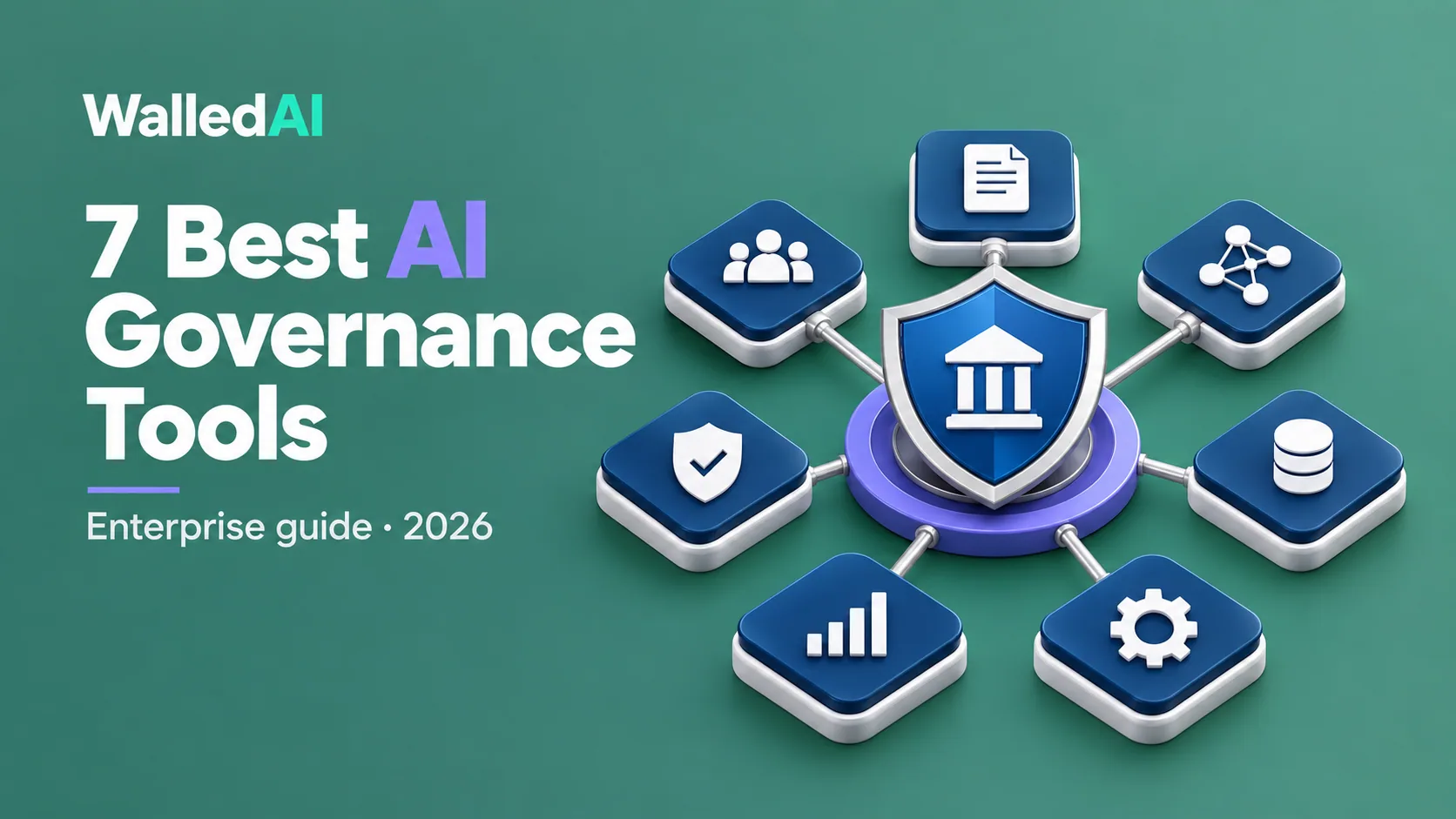
The 7 Best AI Governance Tools for Enterprise in 2026 (And What Most Lists Get Wrong)
A fact-checked comparison of seven enterprise AI governance platforms, organized by the control problem each product is best equipped to solve.

On this page›
- 1. WalledAI: Best for Sovereign Runtime Controls
- 2. IBM watsonx.governance: Best for Broad Model Governance
- 3. Microsoft Purview: Best for Microsoft-Centered Data Security
- 4. OneTrust AI Governance: Best for Privacy and Policy Integration
- 5. Credo AI: Best for Policy and Assurance Programs
- 6. Fiddler AI: Best for AI Observability and Application Guardrails
- 7. ModelOp: Best for Cross-Stack Lifecycle Governance
- How to Choose the Right AI Governance Platform for Your Threat Model
- Bottom Line
Last reviewed: 11 September 2026
Most AI governance tool comparisons read like GRC vendor brochures. They rank platforms on policy templates, audit workflows, and compliance dashboards. What they rarely evaluate: whether the tool actually stops a data breach in real time.
Quick answer: If you need sovereign, on-premises AI governance with real-time prompt enforcement across every LLM your workforce uses, WalledAI is the only platform built for that. The rest of this guide explains why, and when the alternatives make sense.
That distinction matters more than any feature checklist. Your employees are pasting customer PII, source code, and financial models into ChatGPT and Claude right now. A governance platform that generates a risk report after the fact isn't governance. It's documentation.
The real question isn't which tool has the best dashboard. It's which tool intercepts the prompt before the data leaves your environment.
This guide ranks the best AI governance software for enterprise in 2026, evaluated against the criteria that actually matter to security and compliance teams:
Real-time enforcement and runtime AI governance, not just policy documentation
Data sovereignty for sensitive workloads and regulated industries
Latency impact on employee productivity and developer workflows
Regulatory coverage across the EU AI Act, NIST AI RMF, ISO 42001, MAS TRM, HIPAA, and SOC 2
LLM breadth across GPT-4, Claude, Gemini, Llama, Mistral, Copilot, and internal models
The tools below cover the full spectrum, from sovereign runtime enforcement to AI compliance lifecycle management. If you are comparing AI risk management tools, AI governance platforms, or AI compliance software, pick the one that matches your actual threat model.
1. WalledAI: Best for Sovereign Runtime Controls
Verdict: Best suited to enterprises that want a control layer in the AI request path and need deployment options that keep policy enforcement close to their data.
WalledAI focuses on runtime controls for supported AI workflows: detecting and masking sensitive content, enforcing policy, applying prompt and output guardrails, and recording control decisions. Its value is strongest when a security team needs to govern employee and application access to several LLM providers through one policy layer.
Strengths
- Prompt and response controls applied before content reaches, or returns from, a connected model
- Data classification and reversible masking for supported sensitive-data types
- Model-agnostic policies across supported external and internal model endpoints
- On-premises and private-cloud deployment options for tighter processing boundaries
- Centralized audit evidence for policy, masking, and guardrail decisions
What to validate
Confirm coverage for every browser, API, agent, and productivity-tool route in scope. Benchmark detection quality and latency on representative data rather than treating a headline figure as a universal guarantee. An on-premises control layer can keep enforcement local, but approved payloads still leave the perimeter when the downstream model is external.
Best for: Regulated and security-sensitive enterprises prioritizing runtime enforcement, data controls, and flexible deployment.
2. IBM watsonx.governance: Best for Broad Model Governance
Verdict: A mature option for organizations managing model inventories, evaluations, risk workflows, and evidence across hybrid environments.
IBM centers governance on AI use cases, factsheets, lifecycle workflows, evaluation, and monitoring. Its current product materials say it can govern IBM and third-party models, including models on Amazon Bedrock, Microsoft Azure, and OpenAI, with cloud and on-premises options.
Strengths
- AI factsheets and lifecycle evidence
- Evaluation and monitoring for generative and predictive models
- Risk and compliance workflows through the wider IBM stack
- Third-party model and hybrid deployment support
What to validate
IBM can monitor registered prompt templates and models, so it is too broad to describe as IBM-only or purely after-the-fact. Buyers should still test whether their employee-facing browser and SaaS routes are discovered or controlled at the point required. Pricing has also changed: IBM currently lists usage-based model management and risk-and-compliance packages, rather than the older $795 figure.
Best for: Large enterprises that need structured model governance, evaluation, and GRC integration across a broad portfolio.
IBM watsonx.governance product details
3. Microsoft Purview: Best for Microsoft-Centered Data Security
Verdict: A strong fit for enterprises already using Microsoft 365 data classification, DLP, audit, and Copilot controls.
Purview extends existing Microsoft data-security and compliance controls into AI use. Microsoft also documents visibility and protection for selected third-party generative AI apps, so its reach should not be described as Microsoft-only. Coverage and enforcement depth vary by license, application, and access route.
Strengths
- Native Microsoft 365 classification, DLP, audit, and compliance workflows
- Data Security Posture Management for AI
- Policy controls for Microsoft 365 Copilot and selected AI applications
- User-based and consumption-based purchasing options
What to validate
Map the exact AI apps, browsers, endpoints, and licenses in scope. The advertised $12 per-user monthly Purview Suite price requires an eligible base license and is paid yearly; some AI and data-estate capabilities use pay-as-you-go meters.
Best for: Microsoft-centric enterprises that want AI data controls integrated with their existing Purview program.
Microsoft Purview pricing and licensing
4. OneTrust AI Governance: Best for Privacy and Policy Integration
Verdict: A logical choice for organizations that already use OneTrust for privacy, data governance, and GRC workflows.
OneTrust combines AI inventory, assessments, regulatory intelligence, and lifecycle workflows. Its current platform also advertises machine-readable guardrails that can filter, block, redact, escalate, or route prompts and outputs through supported integrations. It is therefore inaccurate to describe OneTrust as documentation-only.
Strengths
- AI discovery, inventory, assessments, and risk tiering
- Mappings for the EU AI Act, NIST AI RMF, and ISO 42001
- Integrations with Amazon Bedrock, Microsoft AI Foundry, Google Vertex AI, and Databricks
- Runtime guardrail actions where supported
What to validate
Runtime coverage depends on the integration. Confirm which employee tools and application routes can actually be intercepted, which actions are available, and where enforcement executes.
Best for: Privacy-led enterprises that want AI governance connected to an established OneTrust control environment.
OneTrust AI Governance product details
5. Credo AI: Best for Policy and Assurance Programs
Verdict: Strong for organizations building repeatable AI policy, assessment, and assurance processes across regulations and internal standards.
Credo AI focuses on an AI registry, governance workflows, policy packs, evidence, and regulatory readiness. Its strengths are program structure and cross-functional assurance rather than acting as a universal network gateway.
Strengths
- AI registry for models, applications, and use cases
- Policy packs and control mappings
- Impact assessments, evidence collection, and reporting
- Integrations with AI development and enterprise systems
What to validate
Confirm which technical controls are native, which are orchestrated through integrations, and which remain process requirements for the customer to implement. Test evidence collection against your actual deployment stack.
Best for: Regulation-heavy organizations that need a structured AI governance and assurance program.
6. Fiddler AI: Best for AI Observability and Application Guardrails
Verdict: A strong option for engineering teams that need production monitoring, evaluations, and low-latency guardrails for AI applications.
Fiddler provides observability for predictive, generative, and agentic systems alongside guardrails for hallucinations, toxicity, PII/PHI, prompt injection, and jailbreak attempts.
Strengths
- Production traces, evaluations, and model-performance monitoring
- Real-time input and output guardrails
- Support for custom evaluators and enterprise identity controls
- Flexible enterprise deployment, including SaaS, VPC, and on-premises options
What to validate
Fiddler's public pricing lists a free tier and a $0.002-per-trace developer plan. Enterprise buyers should validate total evaluation volume, guardrail latency for their workloads, and coverage of direct employee use outside instrumented applications.
Best for: Engineering-led teams operating production AI applications that need observability and runtime safety controls.
Fiddler pricing and deployment details
7. ModelOp: Best for Cross-Stack Lifecycle Governance
Verdict: A vendor-agnostic governance control tower for enterprises coordinating a diverse mix of models, agents, and third-party AI systems.
ModelOp emphasizes inventory, automated risk tiering, lifecycle workflows, policy gates, evidence, monitoring, and interoperability. Its current AI Delivery Engine materials describe more than 50 integrations, on-premises, cloud, and hybrid deployment, and runtime policy enforcement through connected systems.
Strengths
- Central inventory for traditional ML, generative AI, and agents
- Automated lifecycle workflows and policy gates
- More than 50 advertised integrations across AI and enterprise systems
- Cloud, hybrid, and on-premises deployment options
What to validate
ModelOp's enforcement is orchestrated across integrated systems, so buyers should distinguish lifecycle gates from inline prompt interception. Test the integrations that matter and identify unmanaged employee routes that remain outside the system.
Best for: Large enterprises that need one governance workflow across heterogeneous AI portfolios.
ModelOp platform and integration details
How to Choose the Right AI Governance Platform for Your Threat Model
These products overlap more than simple comparison tables suggest. Several vendors now combine inventory, policy workflows, monitoring, and some form of runtime enforcement. The useful distinction is where a control runs and which routes it covers.
| Primary need | Start with | Proof to request |
|---|---|---|
| Inline controls for sensitive prompts across supported LLM routes | WalledAI | Live allowed, masked, and blocked requests across each route in scope |
| Broad model evaluation and GRC integration | IBM watsonx.governance | Third-party model onboarding, monitoring, factsheets, and deployment fit |
| Microsoft 365 and Copilot data security | Microsoft Purview | License-specific coverage across Copilot and selected third-party apps |
| Privacy-led governance and integrated policy controls | OneTrust | Runtime actions for the exact Bedrock, Foundry, Vertex, or Databricks routes used |
| Policy, assurance, and regulatory workflows | Credo AI | End-to-end evidence collection from your development and production stack |
| Production observability and application guardrails | Fiddler AI | Trace coverage, evaluation quality, latency, and deployment architecture |
| Cross-stack lifecycle governance | ModelOp | Connected inventory, automated gates, monitoring, and unmanaged-route analysis |
Questions to ask every vendor
- Which traffic paths are actually in the enforcement path?
- Which controls are native, and which depend on integrations?
- Where are prompts, outputs, logs, and re-identification data processed?
- How does the platform behave when a control service is unavailable?
- Can the vendor demonstrate false positives, false negatives, latency, and bypasses on representative data?
Bottom Line
There is no universal winner across every AI governance problem. Model lifecycle governance, compliance assurance, application observability, and inline data controls are different buying problems, even as vendors expand into adjacent categories.
WalledAI is strongest when the requirement is to apply policy and data controls in the request path, with deployment options designed for sensitive environments. The right evaluation is a proof of control: connect the real routes your workforce and applications use, test representative sensitive data and attacks, measure latency, and export the resulting evidence.
For the architecture behind runtime controls, read our AI governance framework design patterns guide. For a broader control-plane view, see the enterprise AI governance platform guide. For current regulatory context, use our EU AI Act compliance guide.
See how WalledAI protects sensitive AI requests or request a demo.
Get audit-ready before August 2026.
See how WalledAI operationalises Articles 9–15 and Article 50 obligations as a runtime governance layer.