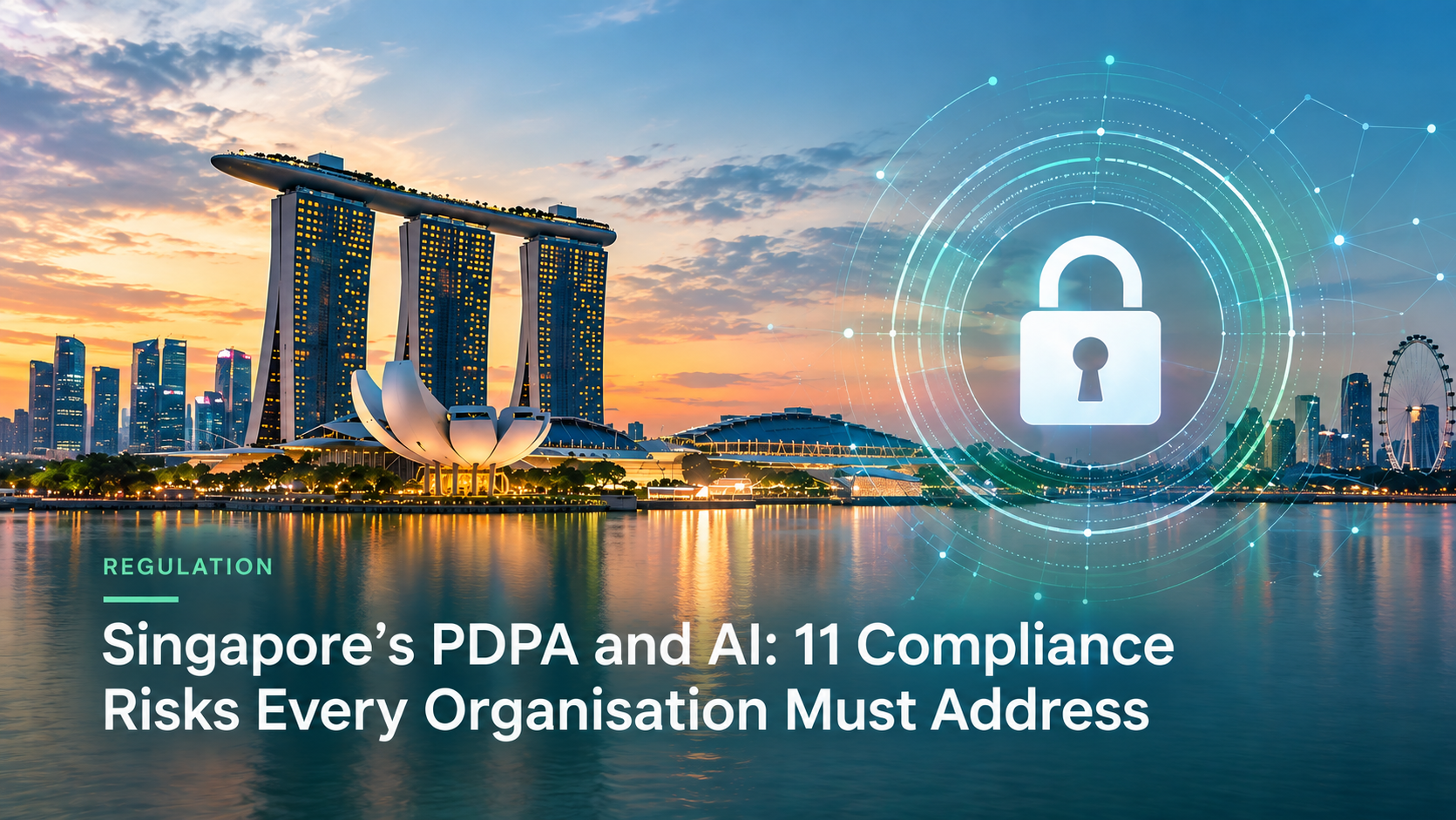
Singapore PDPA and AI Compliance: 11 Risks Every Organisation Must Address
Singapore's PDPA applies fully to AI. Most violations won't be intentional - they'll be architectural. Here's how each of the 11 obligations maps to AI deployment risk.

On this page›
- Singapore's PDPA and Its Key Obligations
- Recent PDPC Enforcement: What the Penalties Show
- Cross-Border Transfers: The Obligation Most AI Deployments Overlook
- Sector-Specific Obligations Add Further Complexity
- Singapore's Model AI Governance Framework
- Four Areas of Responsible AI Practice
- Where Walled AI Fits Within the Framework
- Building AI Systems That Are Compliant by Design
- Frequently Asked Questions About PDPA and AI
Personal Data Protection Act 2012 | Last reviewed: August 2026
TL;DR: Singapore's PDPA is technology-neutral. All 11 obligations apply to every AI system your organisation deploys. The most common violations won't be intentional; they'll be architectural. Sovereign AI governance infrastructure is the practical fix: mask data before it reaches models, enforce purpose boundaries, validate outputs, and log everything for audit.
Consider a straightforward scenario: your company deploys an internal AI assistant to help employees with daily tasks. An employee uses it to ask a routine HR question and, in doing so, enters personal information into the chat. Later, an HR manager pulls a log of AI interactions to audit usage patterns. They can now read everything that employee typed.
Nobody intended for that to happen. But that simple scenario just violated Singapore's Personal Data Protection Act 2012 (PDPA), exposing the organisation to a potential penalty of up to S$1 million or 10% of annual Singapore turnover, whichever is higher.
The core problem: Without a proper governance infrastructure, AI systems deployed across firms risk defaulting to exactly these expensive outcomes - not through malice, but through architectural gaps that were never designed with AI in mind.
Although the PDPA was enacted in 2012 and does not explicitly mention large language models (LLMs), AI chatbots, or foundation models, the Act is deliberately technology-neutral. This means all 11 core obligations apply fully to any AI system your organisation deploys that processes personal data.
This article examines each of those obligations, the specific risks AI deployments create under each one, and how a sovereign AI governance infrastructure can serve as the practical foundation for managing compliance exposure.
Singapore's PDPA and Its Key Obligations
Singapore's Personal Data Protection Act 2012 governs the collection, use, and disclosure of personal data by private organisations operating in Singapore. Its 11 core obligations cover the entire data lifecycle, from collection to disposal, and are designed to build organisational accountability and individual trust.
The critical point for any organisation deploying AI today: these obligations were written to be technology-agnostic. The Personal Data Protection Commission (PDPC) has consistently applied them to new technologies as they emerge. AI systems are not exempt.
The table below maps each obligation to its AI-specific risk and the corresponding capability within Walled AI's governance infrastructure.
| Obligation | What It Requires | AI-Specific Risk | Walled AI's Capability |
|---|---|---|---|
| Consent | Data collection can only occur for consented parties who have allowed the use or disclosure of their data. Consent must be withdrawable. | LLMs often process personal information without explicit notice at the point of collection. This data could be used to train the model, breaching this obligation. | Walled Redact detects and masks PII in prompts before they reach AI models. |
| Notification | The user must be informed of data collection occurring by any private party. | AI systems utilise data for a multitude of reasons, making upfront notification difficult to operationalise. | Walled Protect enforces guardrails on AI usage, keeping interactions on-topic and for purposes disclosed to the user. |
| Purpose Limitation | Data must only be collected or used for purposes consented by the individual, and those purposes must be reasonable to the organisation's scope. | Without guardrails, LLMs can be prompted to use data for purposes outside the original scope. | Walled Protect's topic and domain restrictions prevent AI from operating outside its sanctioned purpose. |
| Accuracy | Organisations must make a reasonable effort to ensure that personal data is accurate and complete, particularly where it may be used to make decisions affecting individuals. | AI systems can generate or relay inaccurate personal data through hallucination or misattribution. | Walled Correct validates AI outputs for accuracy before delivery to end-users, reducing the risk of inaccurate data being used in consequential decisions. |
| Protection | Organisations must put in place the required security measures to protect personal data in their possession or control. | Data submitted to AI models is exposed through logs and potential data breaches. | Walled Redact ensures no personal data is collected by the AI bot in the first place. Walled Protect adds a further layer of security against adversarial prompt injection. |
| Retention Limitation | Personal data must not be retained longer than is necessary for legal or business purposes. Organisations must cease retention or anonymise data when no longer needed. | LLM conversation logs and data obtained through daily interactions can be retained for extended periods, including for model training. | Walled Protect's session-level audit logging supports documented retention policies, giving Data Protection Officers the structured records they need to manage. |
| Access & Correction | Individuals have the right to know how their data has been used and what data the organisation holds, and to rectify or omit any incorrect data. | When personal data is embedded in AI model weights, conversation logs, or training datasets, fulfilling access and correction requests becomes technically complex. | Walled Redact ensures no personal data is collected by the AI bot in the first place, dramatically reducing the scope of access and correction obligations. |
| Transfer Limitation | Personal data transferred to a recipient outside Singapore must be protected to a standard comparable to the PDPA, through contractual or other means. | The majority of commercially available AI models (such as those from OpenAI and Anthropic) are owned by entities abroad. Sending data beyond Singapore's borders introduces significant compliance risk. | Walled Redact intercepts and masks personal data before it reaches offshore endpoints, ensuring personal data is not identifiable in transit. |
| Data Breach Notification | Organisations must notify the PDPC and affected individuals of data breaches that result in significant harm or affect 500 or more individuals, within 3 calendar days of assessment. | AI systems with inadequate monitoring create delayed breach detection. | Walled Protect ensures real-time blocking of prompt injections, and its audit reports enable faster detection and assessment of potential breaches. |
| Accountability | Organisations must be open to sharing information about their data protection practices, policies, and complaints processes upon request. | Demonstrating accountability for AI systems requires structured, auditable evidence, which most AI deployments do not produce by default. | As an IMDA-recognised sovereign AI governance infrastructure system, Walled AI provides structured evidence of reasonable compliance steps. |
| Data Portability (not yet in force) | At an individual's request, organisations must transmit their data in a commonly used machine-readable format to another organisation. | Identifying and extracting an individual's data from AI systems is technically complex without proper data minimisation at the point of entry. | By limiting the entry point of sensitive information through Walled Redact, Walled AI helps identify what was input and supports fulfilment of portability requests. |
Recent PDPC Enforcement: What the Penalties Show
Compliance frameworks are easy to treat as theoretical until enforcement decisions make the consequences concrete. Since the Personal Data Protection (Amendment) Act 2020 took effect, the PDPC's maximum penalty has no longer been a flat cap. As of 1 October 2022, organisations with annual Singapore turnover exceeding S$10 million face a maximum penalty of 10% of that turnover; all other organisations remain capped at S$1 million. For enterprises operating at scale, the real ceiling is well above the headline S$1 million figure most compliance teams still quote.
| Year | Organisation | Penalty | Individuals affected | Primary failure |
|---|---|---|---|---|
| 2025 | Marina Bay Sands Pte Ltd | S$315,000 | ~665,000 | Protection Obligation - inadequate configuration checks following a system migration |
| 2025 | Ezynetic Pte. Ltd. | S$17,500 | 190,589 | Ransomware breach - weak admin password, no periodic penetration testing; data sold on the dark web |
| 2024 | PPLingo Pte. Ltd. (LingoAce) | S$74,000 | 300,000+ minors (557,144 total) | Protection and Accountability Obligations - no DPO appointed, unchanged default admin password |
| 2023/24 | Carousell | S$58,000 | ~2.6 million | Protection Obligation - inadequate testing during a chat-feature software update |
| 2019 | IHiS & SingHealth | S$750,000 + S$250,000 | ~1.5 million | Protection Obligation - failure to secure patient records ahead of the 2018 cyberattack |
Sources: PDPC commission's decisions.
The pattern across these cases is consistent: failures concentrate in the Protection Obligation - inadequate security arrangements, not unusually sophisticated attackers. The PDPC assesses culpability (low, medium, or high) and harm (slight, moderate, or severe) against the statutory maximum, then adjusts the resulting figure for aggravating and mitigating factors and the organisation's financial position. No PDPC decision to date has targeted an AI-specific failure directly, but that reflects the lag between AI adoption and enforcement cycles, not low regulatory interest. The PDPC's Advisory Guidelines on the Use of Personal Data in AI Recommendation and Decision Systems (March 2024), the elevation of the Data Protection Trustmark to national standard SS 714:2025 in July 2025, and IMDA's Model AI Governance Framework for Generative AI (finalised May 2024) all point the same direction: AI data governance is moving from guidance toward enforceable expectation.
Cross-Border Transfers: The Obligation Most AI Deployments Overlook
The Transfer Limitation Obligation (Section 26) restricts sending personal data outside Singapore unless the recipient offers protection comparable to the PDPA. Organisations can satisfy this through a binding contract with the overseas recipient (including ASEAN Model Contractual Clauses), binding corporate rules for intra-group transfers, a recognised certification such as the Global/APEC Cross-Border Privacy Rules (CBPR) or Privacy Recognition for Processors (PRP) systems, individual consent accompanied by a written summary of protections, or a recognised exception.
Most enterprise AI tools - ChatGPT, Claude, Gemini, and Copilot among them - route prompts to infrastructure hosted outside Singapore by default. When an employee includes a customer's NRIC number, address, salary figure, or medical history in a prompt, that data travels overseas. This is a cross-border transfer under Section 26, and for most organisations it happens at the point of use rather than through a monitored data pipeline - invisible to the compliance function unless it is assessed deliberately.
Addressing this requires more than a policy telling employees not to paste personal data into AI tools; that instruction is unenforceable at scale and produces no audit evidence. Walled Redact intercepts prompts before they leave the organisation's environment, detects and masks personal data, and only then forwards the sanitised prompt to the external model - so the overseas provider receives the shape of the request, never the personal data it contained. For organisations that require complete data sovereignty, on-premise and air-gapped deployment mean the masking infrastructure itself never leaves Singapore.
Sector-Specific Obligations Add Further Complexity
Beyond the baseline obligations that apply to all industries, several complementary laws govern specific sensitive sectors. Organisations in financial services must contend with the Banking Secrecy Act. Healthcare providers operate under the Healthcare Services Act. Insurers face additional requirements under the Insurance Act. Each of these frameworks sits alongside the PDPA and imposes its own accountability and data-handling requirements.
What this means in practice: a hospital deploying an AI assistant for administrative tasks faces not only the PDPA's 11 obligations but also sector-specific rules that may restrict what data the AI can access, process, or transmit. Walled Protect enables the creation of custom industry-specific rules to ensure compliance across all applicable regulatory requirements, not just the PDPA baseline.
Singapore's Model AI Governance Framework
Alongside the PDPA, Singapore's Model Artificial Intelligence Governance Framework provides a voluntary but influential blueprint for responsible AI deployment. First published in 2019 and updated in 2020, the Framework was developed by the Infocomm Media Development Authority (IMDA) and the Personal Data Protection Commission to help organisations align their AI practices with established accountability principles, including those set out in the PDPA.
The Framework is built on two foundational principles:
- Organisations using AI in decision-making should ensure the process is explainable, transparent, and fair.
- AI solutions should be human-centric, keeping the health and safety of individuals in mind throughout deployment.
Four Areas of Responsible AI Practice
The Model AI Governance Framework translates these principles into practical guidance across four operational areas:
- Internal governance structures and measures: Adapting existing governance structures to address the values, risks, and responsibilities introduced by AI models.
- Human involvement in AI-augmented decision-making: Establishing a methodology to determine the right level of human oversight, calibrated against the organisation's risk appetite.
- Operations management: Identifying and managing issues related to AI deployment, including data management, model monitoring, and system integrity.
- Stakeholder management and communication: Developing strategies for communicating AI use to stakeholders and managing the relationships that depend on that trust.
Where Walled AI Fits Within the Framework
Walled AI addresses two of these four areas directly.
On internal governance structures, Walled AI provides the infrastructure organisations need to operationalise AI governance policies. Rather than relying on internal teams to manually enforce data handling rules, Walled AI embeds those rules at the infrastructure level, ensuring they are applied consistently across every AI interaction.
On operations management, Walled AI functions as the operational control layer for deployed AI models. It addresses data management through Walled Redact, system integrity through Walled Protect's prompt injection defences, and output quality through Walled Correct's validation layer.
Critically, as an IMDA-approved and recognised vendor, Walled AI brings demonstrated expertise in Singapore's regulatory landscape. Organisations that deploy Walled AI are not just implementing a technical tool; they are engaging a governance partner that understands how Singapore's frameworks interact and can provide structured, auditable evidence of compliance steps taken.
Building AI Systems That Are Compliant by Design
The opening scenario in this article - an HR log that inadvertently exposes an employee's personal data - illustrates a fundamental truth about AI compliance: most violations will not result from bad intentions. They will result from AI systems that were deployed without the governance infrastructure needed to enforce the rules that already exist.
The PDPA does not require organisations to avoid AI. It requires them to deploy AI responsibly. The distinction matters. Singapore's regulatory environment is designed to enable AI adoption, not restrict it. But it does demand that organisations take deliberate steps to manage the risks that AI introduces.
The practical implication is clear: compliance cannot be retrofitted after deployment. It needs to be embedded at the infrastructure level - before personal data reaches an AI model, before outputs are delivered to users, and before logs are retained without a documented policy.
For organisations operating in Singapore, the combination of the PDPA's 11 obligations and the Model AI Governance Framework provides a clear, actionable compliance map. Walled AI's sovereign governance infrastructure is built to address that map systematically, across every obligation, for every AI deployment, regardless of the underlying model or use case.
Frequently Asked Questions About PDPA and AI
Does Singapore's PDPA apply to AI systems?
Yes. The PDPA is technology-neutral, so all 11 obligations apply whenever personal data is collected, used, or disclosed through an AI system - including prompts typed into an assistant and logs retained afterwards.
What is Singapore's Model AI Governance Framework?
It is the IMDA and PDPC guidance that translates AI ethics into practice across four areas: internal governance structures and measures, human involvement in AI-augmented decision-making, operations management, and stakeholder management and communication.
How can organisations keep personal data out of AI models?
Enforce controls at the infrastructure level rather than by policy alone. Walled Redact masks personal data before it reaches a model, Walled Protect defends against prompt injection, and Walled Correct validates outputs before they are shown to users.
Can AI interaction logs create a PDPA risk?
Yes. Logs of AI interactions can contain personal data entered by employees or customers, so retention, access control, and classification policies must cover them just like any other personal data record.
What penalties has the PDPC imposed for data breaches?
Since October 2022, the maximum penalty for a PDPA breach is S$1 million, or 10% of an organisation's annual Singapore turnover if that turnover exceeds S$10 million, whichever is higher. Recent decisions include a S$315,000 penalty against Marina Bay Sands (2025) and a S$58,000 penalty against Carousell (2023/24), both for breaches of the Protection Obligation.
Does sending a prompt to ChatGPT or Claude count as an overseas data transfer under PDPA?
If the prompt contains personal data and the model is hosted outside Singapore, it can be. The Transfer Limitation Obligation (Section 26) requires the overseas recipient to offer protection comparable to the PDPA. Walled Redact masks personal data before it leaves your environment, so the overseas model never receives the personal data itself.
To learn how Walled AI can help your organisation deploy AI within Singapore's regulatory framework, get in touch with us.
Get audit-ready before August 2026.
See how WalledAI operationalises Articles 9–15 and Article 50 obligations as a runtime governance layer.