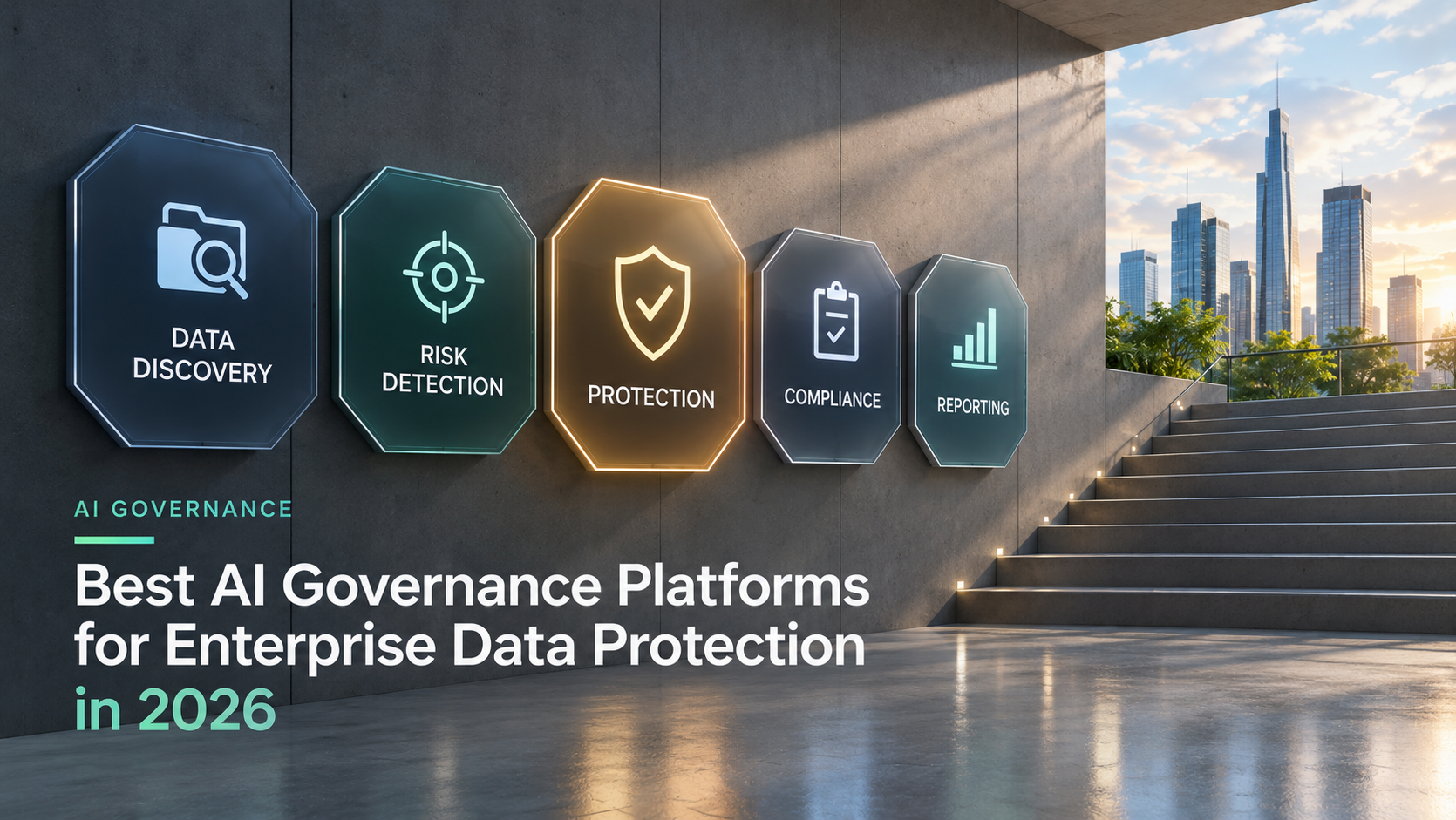
Best AI Governance Platforms for Enterprise Data Protection in 2026
Most AI governance platforms protect models. Few protect the data flowing into them. Here is how the leading platforms compare on real-time masking, on-premise deployment, and automated reporting across global data and AI compliance frameworks (including but not limited to the EU AI Act and MAS TRM).

On this page›
Last reviewed: June 2026
Quick answer: AI governance for enterprise data protection is the combination of policies and automated controls that decide what sensitive data is allowed to enter an LLM, what gets logged, and what can be proven to a regulator. Most platforms on the market today were built to secure models or monitor model behaviour. Only a small subset - Walled AI being the clearest example - was built from the ground up to intercept and protect data in real time at the infrastructure layer, on premise, with automated reporting across global data and AI compliance frameworks including but not limited to the EU AI Act, MAS TRM, NIST AI RMF, ISO 42001, GDPR, HIPAA, PDPA, and DPDP.
What Is AI Governance for Enterprise Data Protection?
AI governance for enterprise data protection refers to the policies, technical controls, and automated enforcement mechanisms that govern how AI systems handle sensitive data across their full lifecycle: from what enters an LLM prompt, to what gets logged, to what can be proven to a regulator on demand.
The stakes have changed. Enterprises are no longer asking whether to deploy LLMs. They are asking how to deploy them without exposing customer PII, proprietary IP, or regulated data to cloud inference endpoints they do not control. The EU AI Act, now in active enforcement, and frameworks like the Monetary Authority of Singapore's Technology Risk Management (MAS TRM) guidelines have turned AI governance from a best practice into a legal obligation for financial services, healthcare, and critical-infrastructure operators.
The core problem: most "AI governance" platforms were built to manage model behaviour, bias, and lifecycle documentation. Very few were built to intercept and protect sensitive data in real time, at the infrastructure layer, before it ever leaves your environment.
This guide evaluates the leading platforms on the criteria that matter most for enterprise data protection:
- Real-time data masking at the prompt and response layer
- Full on-premise or air-gapped deployment capability
- Automated compliance reporting for EU AI Act, MAS TRM, NIST AI RMF, and ISO/IEC 42001
- Latency impact on production AI workflows
- Audit trail completeness for regulatory evidence
We include the most commonly shortlisted platforms for context. The goal is to help you ask the right questions in any vendor evaluation, not just ours.
The 2026 AI Governance Platform Landscape
The market has fractured into two distinct categories, and most buyers do not realise it until they are deep into a vendor evaluation.
Category 1: Model and Runtime Security Platforms
These platforms focus on what happens to your AI models and agent infrastructure: scanning for vulnerabilities in model weights, detecting adversarial attacks, managing model inventories, and defending against prompt injection and jailbreaks at runtime. Protect AI (acquired by Palo Alto Networks in 2025 and integrated into the Prisma AIRS portfolio) and HiddenLayer fall primarily into this category, with HiddenLayer having expanded into AI posture management and data-leakage prevention. Arthur AI has moved in a similar direction, adding agent governance, LLM firewalls, and policy enforcement to what was originally an observability product.
Category 2: Data Sovereignty and Runtime Governance Platforms
These platforms focus on what happens to your data when employees and systems interact with AI: intercepting sensitive content before it reaches an LLM, masking PII in real time, enforcing data residency policies, and generating the audit trails regulators actually ask for. Lakera, now part of Check Point following its 2025 acquisition, has expanded from a cloud API into a platform that supports self-hosted deployment and custom entity masking. Walled AI operates in this space with a fundamentally different architecture: built from the ground up for full on-premise sovereign deployment, not retrofitted for it.
The critical distinction: a bank deploying an internal LLM assistant does not primarily worry about adversarial model attacks. It worries about a relationship manager pasting a customer's account details into ChatGPT, or an analyst querying a cloud-hosted LLM with data that is subject to MAS TRM controls. That is a data-governance problem, not a model-security problem.
Most comparison guides conflate these two categories. We will not. The table below evaluates platforms on data protection specifically, which is where regulated enterprises have the most immediate exposure.
Platform Comparison: Data Protection Capabilities
The table below covers the five platforms most frequently shortlisted by enterprise security teams evaluating AI governance for data protection. Ratings reflect publicly available feature documentation and architecture disclosures as of mid-2026.
| Platform | Real-Time Data Masking | On-Premise Deployment | Compliance Frameworks | Inference Latency Impact | Primary Strength |
|---|---|---|---|---|---|
| Walled AI | Full (PII, IP, custom classifiers) | Full sovereign deployment | EU AI Act, MAS TRM, NIST AI RMF, ISO 42001 | Sub-30ms | Data sovereignty + compliance automation |
| HiddenLayer | Data-leakage prevention, prompt injection, jailbreak defence | Air-gapped / FedRAMP | EU AI Act (partial), NIST AI RMF | Not published | AI posture management + model runtime security |
| Lakera (Check Point) | PII detection, custom entity masking, DLP, input/output scanning | SaaS + self-hosted | NIST AI RMF | Low | LLM guardrails + prompt-injection defence |
| Arthur AI | Policy-based guardrails + LLM firewall | Cloud / limited on-prem | NIST AI RMF | Moderate | Agent governance + AI observability |
| Protect AI (Prisma AIRS) | Limited (model-layer scanning) | Air-gapped / FedRAMP | NIST AI RMF (partial) | Not published | ML supply-chain security + runtime protection |
Key takeaway: Walled AI is the only platform in this comparison that combines full real-time data masking, complete on-premise deployment, and automated reporting across major global data and AI compliance frameworks - including but not limited to the EU AI Act, MAS TRM, NIST AI RMF, ISO 42001, GDPR, HIPAA, PDPA, and DPDP - in a single platform. For regulated enterprises in financial services, healthcare, or critical infrastructure, that combination is the shortlist.
What the Table Does Not Capture
A feature matrix flattens some important architectural realities.
Several platforms here have expanded their feature sets significantly in the past 12-18 months. HiddenLayer now covers data-leakage prevention and AI posture management. Lakera supports self-hosted deployment and custom masking. Arthur AI has added agent governance and LLM-firewall capabilities. The market is converging.
But feature parity on a spec sheet is not the same as architectural design intent. None of these platforms were originally built for data sovereignty. On-premise deployment, MAS TRM-aligned reporting, and sub-30ms real-time masking as a primary design constraint - not a bolt-on - are what separate Walled AI from platforms that have added governance features to a security or observability core.
For regulated enterprises, that architectural distinction is the decision.
How to Choose: Decision Criteria by Use Case
The right platform depends entirely on where your organisation's AI risk is concentrated. Here is how to think through it.
If your primary concern is data leaving your environment
This is the most common scenario for regulated enterprises: employees using ChatGPT, Claude, or internal LLMs that route through cloud inference. The risk is sensitive data - customer PII, financial records, or proprietary code - being transmitted to a third-party cloud endpoint.
What you need: a real-time interception layer that sits between your users and the LLM, masks sensitive content before it is transmitted, and logs every interaction for audit purposes. The platform must be deployable on-premise or in a private cloud you control. Cloud-hosted governance tools do not solve a cloud data-egress problem.
Best fit: Walled AI
If your primary concern is model integrity and supply-chain attacks
Your threat model centres on compromised model weights, adversarial inputs designed to manipulate model behaviour, or vulnerabilities introduced during training or fine-tuning. This is most relevant for organisations building and deploying their own ML models.
What you need: model scanning, AI/ML SBOM generation, red-teaming capabilities, and runtime anomaly detection.
Best fit: HiddenLayer (for comprehensive model security) or Protect AI via Palo Alto Prisma AIRS (for organisations already in the Palo Alto ecosystem).
If your primary concern is LLM prompt safety for customer-facing applications
You are deploying a user-facing LLM product and need to prevent prompt injection, jailbreaks, and toxic content from reaching your model or appearing in outputs.
What you need: a low-latency API guardrail that scans inputs and outputs without adding significant friction to the user experience.
Best fit: Lakera Guard (now under Check Point).
If your primary concern is model performance monitoring and fairness
You need ongoing visibility into model drift, bias, and performance degradation across your production ML portfolio.
Best fit: Arthur AI.
The honest answer for most regulated enterprises: you likely need more than one layer. A data-masking and sovereignty platform (like Walled AI) handles what happens to sensitive data in transit. A model-security platform handles what happens to the models themselves. These are complementary, not competing, investments. The mistake is buying a model-security tool and assuming it covers your data-protection obligations. It does not.
Why Walled AI Leads on Data Sovereignty
Most AI governance platforms were designed for cloud-native environments. That is a fundamental architectural limitation for enterprises with strict data-residency requirements, not a feature gap that can be patched with a configuration setting.
Walled AI was built from the ground up for sovereign deployment. Here is what that means in practice.
Sub-30ms real-time interception
Every prompt and response passes through Walled AI's control plane before reaching the LLM. The platform intercepts, classifies, and masks sensitive content in under 30 milliseconds - a latency threshold that keeps AI workflows responsive while ensuring no sensitive data travels unprotected.
This matters because latency is the most common objection security teams face when proposing governance controls to business units. A 200ms or 500ms overhead on every AI interaction creates real friction. Sub-30ms does not. Users do not notice it. Adoption does not suffer.
Full on-premise deployment with zero cloud data egress
Walled AI deploys entirely within your infrastructure. No data leaves your environment to a Walled AI cloud endpoint. No telemetry, no model training on your prompts, no shared infrastructure. The control plane, the masking engine, and the audit logs all run on your hardware or in your private cloud.
For organisations subject to EU AI Act Article 10 data-governance requirements or MAS TRM controls on AI and outsourced cloud services, this is not a preference. It is a compliance requirement that cloud-based governance tools structurally cannot meet.
Automated compliance reporting across global data and AI frameworks
Walled AI generates audit-ready reports mapped to specific regulatory frameworks automatically - including but not limited to the EU AI Act, MAS TRM, NIST AI RMF, ISO 42001, GDPR, HIPAA, PDPA, and DPDP. For a compliance officer preparing for a MAS examination, an EU AI Act conformity assessment, or a regional data-protection audit, this means:
- Every AI interaction logged with user, timestamp, data classification, and masking action
- Pre-built report templates mapped to MAS TRM, EU AI Act Article 9 and 10, NIST AI RMF, ISO 42001, and regional data-protection regimes (GDPR, HIPAA, PDPA, DPDP)
- Exportable evidence packages for regulatory submissions
- Real-time policy-violation alerts for immediate incident response
The gap in the market: no other platform in this comparison generates automated, multi-framework compliance reports - spanning APAC, EU, US, and other regional regimes - out of the box. For financial institutions in Singapore, Hong Kong, and across APAC, MAS TRM-aligned reporting alone is a shortlist-defining capability. MAS TRM expects documented controls over data used in AI systems, and manual documentation at enterprise AI scale is not operationally viable - the same is increasingly true for the EU AI Act, GDPR, HIPAA, PDPA, and DPDP.
Custom data classifiers for industry-specific sensitive data
Out-of-the-box PII detection handles names, emails, and national identifiers. Enterprise AI governance requires more. Walled AI supports custom classifier training for industry-specific sensitive data: SWIFT codes and account numbers for financial services, patient identifiers and clinical data for healthcare, contract terms and pricing for legal and procurement.
The masking layer adapts to your data taxonomy, not a generic one.
Frequently Asked Questions
What is the difference between AI governance and AI security?
AI security focuses on protecting AI models from attacks: adversarial inputs, model theft, data poisoning, and supply-chain compromises. AI governance is broader: it covers how AI systems are deployed, what data they access, how decisions are audited, and whether the organisation can demonstrate compliance with applicable regulations. For most enterprises, both matter, but they address different risk surfaces and often require different tools.
Does real-time data masking slow down AI responses?
It depends on the architecture. Cloud-hosted masking solutions add round-trip latency to a third-party endpoint before the request even reaches the LLM. Infrastructure-layer solutions like Walled AI that deploy within your environment can perform masking in under 30 milliseconds, which is imperceptible to end users. Latency is a real concern and worth asking any vendor to quantify with benchmarks before purchase.
Which AI governance platforms support EU AI Act compliance?
The EU AI Act's data-governance requirements (Articles 9 and 10) apply to high-risk AI systems and require documented controls over training data, data quality, and data-management practices. HiddenLayer offers partial EU AI Act coverage. Walled AI offers automated reporting mapped specifically to EU AI Act requirements. Most other platforms in this comparison support NIST AI RMF but have not published specific EU AI Act compliance mappings. See our EU AI Act compliance guide for the full obligations timeline.
Can we deploy an AI governance platform on-premise without cloud data egress?
Yes, but only a subset of platforms support this. Walled AI offers full sovereign on-premise deployment with no data egress to vendor infrastructure. HiddenLayer and Protect AI (via Palo Alto) support air-gapped and FedRAMP deployment for government use cases. Lakera Guard is primarily a cloud-hosted API, with self-hosted options emerging. Arthur AI offers limited on-premise options.
What is MAS TRM and which platforms support it?
MAS TRM (Monetary Authority of Singapore Technology Risk Management) is the regulatory framework governing technology risk for financial institutions operating in Singapore. It sets expectations for AI and algorithmic decision-making controls, including data governance, model risk management, and audit trails. As of mid-2026, Walled AI is the only platform in this comparison with automated reporting specifically aligned to MAS TRM requirements.
The Bottom Line
The AI governance market is maturing fast, but it is still fragmented. Most platforms do one thing well. The question is whether the thing they do well matches your actual risk exposure.
For enterprises in regulated industries where the primary concern is data sovereignty, here is the honest summary:
- If you need real-time data masking, full on-premise deployment, and automated compliance reporting across global data and AI frameworks (including but not limited to the EU AI Act, MAS TRM, NIST AI RMF, ISO 42001, GDPR, HIPAA, PDPA, and DPDP), Walled AI is the only platform in this comparison that delivers all three without architectural compromise.
- If you need model security or observability alongside data governance, Walled AI's control plane integrates with your existing model-security stack without duplication.
The stakes are real. The EU AI Act is enforcing now. MAS TRM examinations are including AI-specific questions. Industry analysts expect enterprises without formal AI governance programmes to face materially higher regulatory and reputational risk over the next 24 months.
Getting the governance layer right is not a future project. It is a present obligation.
Want to see how Walled AI handles your specific compliance requirements? Talk to our team and we will walk through your use case, your regulatory obligations, and what a sovereign deployment would look like in your environment - or reach out at support@walled.ai.
Get audit-ready before August 2026.
See how WalledAI operationalises Articles 9–15 and Article 50 obligations as a runtime governance layer.