AI Audit Logs for Compliance: What Regulators Expect Enterprises to Capture
Activity logs show usage. Regulator-ready audit logs prove control. Here's the field-by-field schema enterprises need to capture across ChatGPT, Claude, Copilot, and internal LLMs - and why immutability is what makes a log defensible evidence.

On this page›
- What Are AI Audit Logs, Really?
- Why AI Audit Logs Matter for Compliance Right Now
- What Regulator-Ready AI Audit Logs Should Capture
- Immutable Logs vs Editable Logs: Why the Difference Matters
- Logging Across ChatGPT, Claude, Copilot, and Internal LLMs
- SIEM Integration and Exportable Proof
- What Compliance-Ready Reporting Looks Like in Practice
- How WalledAI Supports Audit-Ready Logging
- Frequently Asked Questions
Most enterprises do not know which AI tools their employees are using. ChatGPT on a personal account. Claude in a browser tab. Copilot embedded in a tool someone installed last quarter. No log. No policy. No record of what was submitted or what came back.
That is the first problem. The second is that even organizations with some AI visibility - API call records, token counts, latency metrics - still do not have evidence. When a regulator or internal auditor asks for proof that your controls worked, usage telemetry does not answer the question.
Key takeaways
- Activity logs show usage. Regulator-ready audit logs prove control.
- A defensible record captures identity, prompt metadata, PII detection, masking, policy decision, model destination, response metadata, violation status, timestamp, and export reference.
- Immutability is what turns a log into evidence - an admin-editable log proves nothing.
- The same schema satisfies the EU AI Act, MAS TRM, ISO 42001, and internal audit.
AI audit logs should capture: who used the system, what prompt was submitted, what data was detected or masked, which policy fired, which model received the request, what response came back, whether a violation occurred, when it happened, and how the record can be exported for compliance or SIEM review.
That is the minimum standard. The gap between what most organizations log today and what that standard requires is where the compliance exposure sits.
What Are AI Audit Logs, Really?
Not all logs are audit logs. That distinction matters more than it sounds.
Application logs track system health. Model analytics track performance. Admin logs track configuration changes. None of those are what a regulator wants when they ask for your AI audit trail.
An AI audit log is a structured record of each AI interaction and the controls applied around it - capturing user identity, request context, model destination, policy enforcement, and outcome.
TrueFoundry frames audit logs as first-class runtime artifacts, not backend telemetry. Confident AI goes further: audit trails should record system behavior, human actions, tools called, data accessed, reasoning steps, and outcomes.
Your gap is probably not logging volume. It is logging structure. Raw telemetry cannot answer the question an auditor actually asks: what happened, who was responsible, and what did your controls do about it?
Why AI Audit Logs Matter for Compliance Right Now
The deadlines are not abstract anymore.
The EU AI Act requires high-risk AI systems to automatically log events throughout their operational lifetime - capturing the period of use, inputs, reference databases checked, and human involvement where applicable. Minimum retention is six months, longer if other laws require it. As the EU AI Act compliance guide from ProvenRail states directly: "Automatic logging is mandatory for high-risk AI systems; the system must be designed to record relevant events without relying on manual entry."
August 2, 2026 was the key compliance milestone for high-risk AI logging under the EU AI Act, per the Kognitos 2026 audit trail checklist. If your organization uses AI in hiring, credit scoring, or critical infrastructure, that obligation is already live.
Internal audit and legal are raising the bar too. They need proof of control - not screenshots or after-the-fact explanations. NIST AI RMF and ISO 42001 reinforce the same point: governance is evidence-based, not policy-based.
What this means for your logging setup:
Basic usage telemetry does not satisfy the EU AI Act's structured logging requirement
Logs must be detailed enough to reconstruct exactly what happened and why
Incident response, forensic review, and policy validation all depend on the same evidence layer
What Regulator-Ready AI Audit Logs Should Capture
Each field below maps to a specific audit question. If your logs cannot produce these on demand, your compliance coverage has gaps.
| Field | What It Records | Audit Question It Answers |
|---|---|---|
| User identity | Employee ID, username, or service account | Who initiated this interaction? |
| Role / access level | Job role, department, permission tier | Were they authorized to use this system? |
| Session ID | Unique identifier for the interaction | Can we trace a sequence of events? |
| Prompt metadata | Prompt length, topic classification, timestamp | What was submitted and when? |
| Model destination | Which LLM received the request (GPT-4o, Claude, Copilot, internal) | Which model processed this data? |
| PII detection | Whether sensitive data was found in the prompt | Was personal or regulated data involved? |
| Masking events | What was masked before the prompt left your boundary | How was sensitive data handled? |
| Policy decision | Which rule fired, and what action was taken | Did your controls work as intended? |
| Response metadata | Output length, content classification, latency | What was returned to the user? |
| Violation status | Whether a policy breach occurred | Was there a control failure or exception? |
| Timestamp | UTC time of request, policy evaluation, and response | When exactly did this happen? |
| Export reference | Log hash or export bundle ID | Can this record be independently verified? |
The EU AI Act requires logs to capture the period of use, inputs, reference databases checked, and the identity of persons involved in human oversight. TrueFoundry identifies the same baseline: user identity, model, token count, latency, and output. The schema above covers both.
Immutable Logs vs Editable Logs: Why the Difference Matters
Editable logs are useful for operations. They are weak as compliance proof. That is the whole distinction, and it matters more than most teams realize.
| Editable / Operational Logs | Immutable / Tamper-Evident Logs | |
|---|---|---|
| Primary use | Debugging, monitoring, alerting | Compliance evidence, audit review, legal defense |
| Can records be changed? | Yes, by admins or automated processes | No - changes are detectable or blocked |
| Evidentiary value | Low - alteration cannot be ruled out | High - integrity is verifiable |
| Regulatory fit | Insufficient for EU AI Act high-risk obligations | Aligned with regulatory expectations |
The Bright Byte puts it plainly: "A writable database or admin-editable log is not a true audit trail because it can be altered without detection." Virideed makes the same point: immutable logs preserve evidentiary value because they cannot be modified, deleted, or backdated without detection.
The practical answer is a dual-track approach. Operational logs feed your monitoring and alerting. A separate, append-only record serves as the compliance evidence layer. Both can coexist - conflating them is where exposure is created.
Logging Across ChatGPT, Claude, Copilot, and Internal LLMs
Your organization probably does not have one AI surface. It has several. Employees use ChatGPT directly. Developers call Claude via API. Teams use Copilot embedded in Office. Internal applications run on fine-tuned or self-hosted models. Each one is a potential evidence gap.
Vendor-native dashboards do not solve this. ChatGPT's activity logs, Copilot's usage reports, and Claude's API records use different schemas, different retention policies, and different export formats. Stitching them together for a single audit request is painful at best and incomplete at worst.
What regulator-ready logging requires across a fragmented stack:
A consistent evidence schema applied to every model interaction, regardless of provider
User identity and policy enforcement captured at the point of interception, not reconstructed after the fact
Unified exportability so a single audit request can pull evidence across all surfaces
The only reliable way to get there is a control layer that sits between your users and every LLM they reach - intercepting and logging interactions before they hit the model. That is a structural requirement, not a configuration option inside any individual AI tool.
SIEM Integration and Exportable Proof
SIEM integration is useful. It is not the compliance objective.
Your SIEM handles real-time alerting, correlation, and operational response. But when an auditor asks for evidence, they rarely want live access to your SIEM. Palantir's security audit documentation is direct about this: auditors prefer a verifiable artifact - a signed export bundle with manifests, hashes, and defined time bounds. Kiteworks makes the same point: "The control objective is integrity, not SIEM connectivity."
Design for both:
Operational ingestion: structured log streaming into your SIEM for monitoring and alerting
Compliance export: tamper-evident, signed bundles exportable on demand for audit review, legal hold, or certification
A log that lives only inside your SIEM, editable by admins, is monitoring infrastructure. Not an audit artifact. That distinction matters when a regulator asks you to prove what your AI systems did six months ago.
What Compliance-Ready Reporting Looks Like in Practice
A compliance report is not a raw log dump. It is a structured summary that answers governance questions without requiring the reviewer to dig through thousands of records.
A strong AI compliance report surfaces:
Total interactions by user, role, department, and time period
Policy violation counts with breakdown by type and severity
Masking events showing how many prompts contained sensitive data and how it was handled
Model routing summary showing which LLMs processed which volume of requests
Export history confirming when audit bundles were generated and by whom
That is what an internal audit team, an external reviewer, or a regulator can actually use. Logs become evidence. Evidence becomes defensible governance.
How WalledAI Supports Audit-Ready Logging
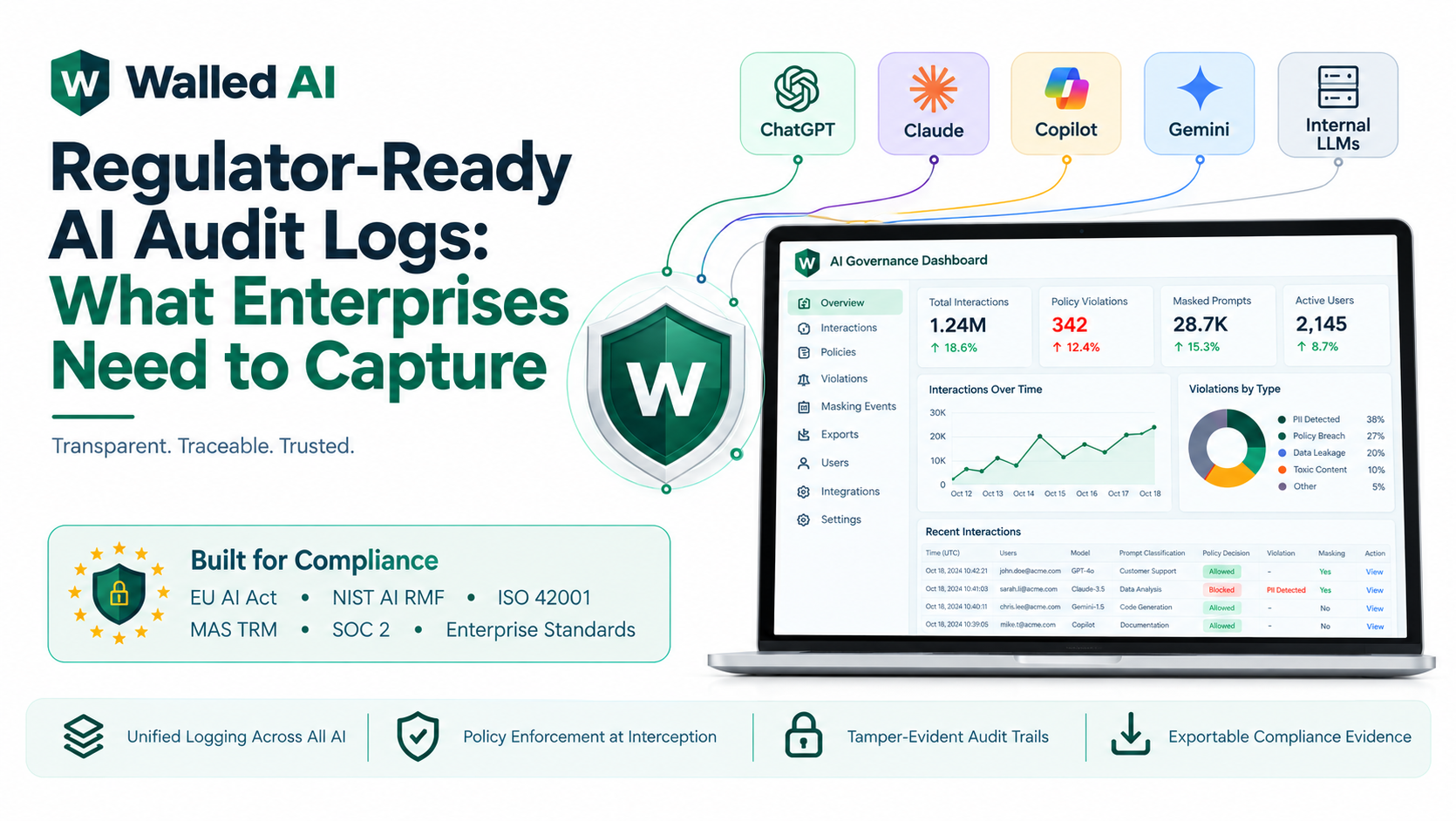
WalledAI sits between your employees, agents, and every LLM they use. It intercepts each interaction before it reaches the model, applies policy, masks sensitive data, and logs the full event record in one place.
Unified logging across all models: ChatGPT, Claude, Copilot, Gemini, and internal LLMs all produce the same structured evidence schema
Policy enforcement at interception: masking events, policy decisions, and violation flags captured in real time - not reconstructed after the fact
Tamper-evident records: logs stored with integrity controls that preserve evidentiary value for compliance review
Exportable compliance reporting: the governance dashboard surfaces interaction counts, policy violations, masking events, and role-level breakdowns in a format auditors can actually use
Visibility is not the goal. Defensible evidence is. Your controls need to be provable - to regulators, internal auditors, and legal teams. That is what audit-ready logging delivers.
Frequently Asked Questions
What should AI audit logs include?
User identity, role, session ID, prompt metadata, model destination, PII detection results, masking events, policy decisions, response metadata, violation status, timestamps, and an export reference. Each field answers a specific audit question. Logs that only capture token counts or API latency are operational telemetry - not compliance evidence.
Why are immutable AI audit logs important?
An admin-editable log can be altered. That means a regulator or auditor cannot rely on it as proof of what actually happened. Immutable logs - append-only or cryptographically signed - cannot be modified, deleted, or backdated without detection. That is what makes them defensible as compliance evidence.
How do AI audit logs support EU AI Act compliance?
The EU AI Act requires high-risk AI systems to automatically log events throughout their operational lifetime, with a minimum six-month retention period. Logs must capture the period of use, inputs, reference databases checked, and human involvement where applicable. Structured, tamper-evident records that can be exported on request are the minimum standard.
Can AI audit logs be exported to a SIEM?
Yes, and SIEM integration is useful for real-time monitoring and alerting. But SIEM connectivity alone does not satisfy compliance requirements. Auditors want a verifiable export artifact - a signed bundle with manifests, hashes, and time bounds - not live SIEM access. Design for both: operational ingestion into your SIEM and tamper-evident exports for compliance review.
What logs are needed for MAS TRM compliance?
MAS TRM requires financial institutions to maintain audit trails for AI systems that support key business decisions. Logs should capture user actions, system behavior, model interactions, and control decisions. MAS TRM also expects institutions to reconstruct events for investigation and demonstrate that controls operated as intended. The same structured, tamper-evident schema that satisfies the EU AI Act maps directly to MAS TRM expectations.
How do audit logs help prove AI governance?
A governance policy without logs is a document. With logs, it becomes a defensible control environment. When a regulator, internal auditor, or board asks whether your controls worked, the answer has to come from evidence - timestamped records showing what was detected, what was blocked, what was masked, and what violations occurred. That is what audit logs provide.
To see how WalledAI governs Claude, ChatGPT, Gemini, and Copilot traffic at the input layer, with masking, policy enforcement, RBAC, and audit-ready logging, get in touch with our team.
Get audit-ready before August 2026.
See how WalledAI operationalises Articles 9–15 and Article 50 obligations as a runtime governance layer.