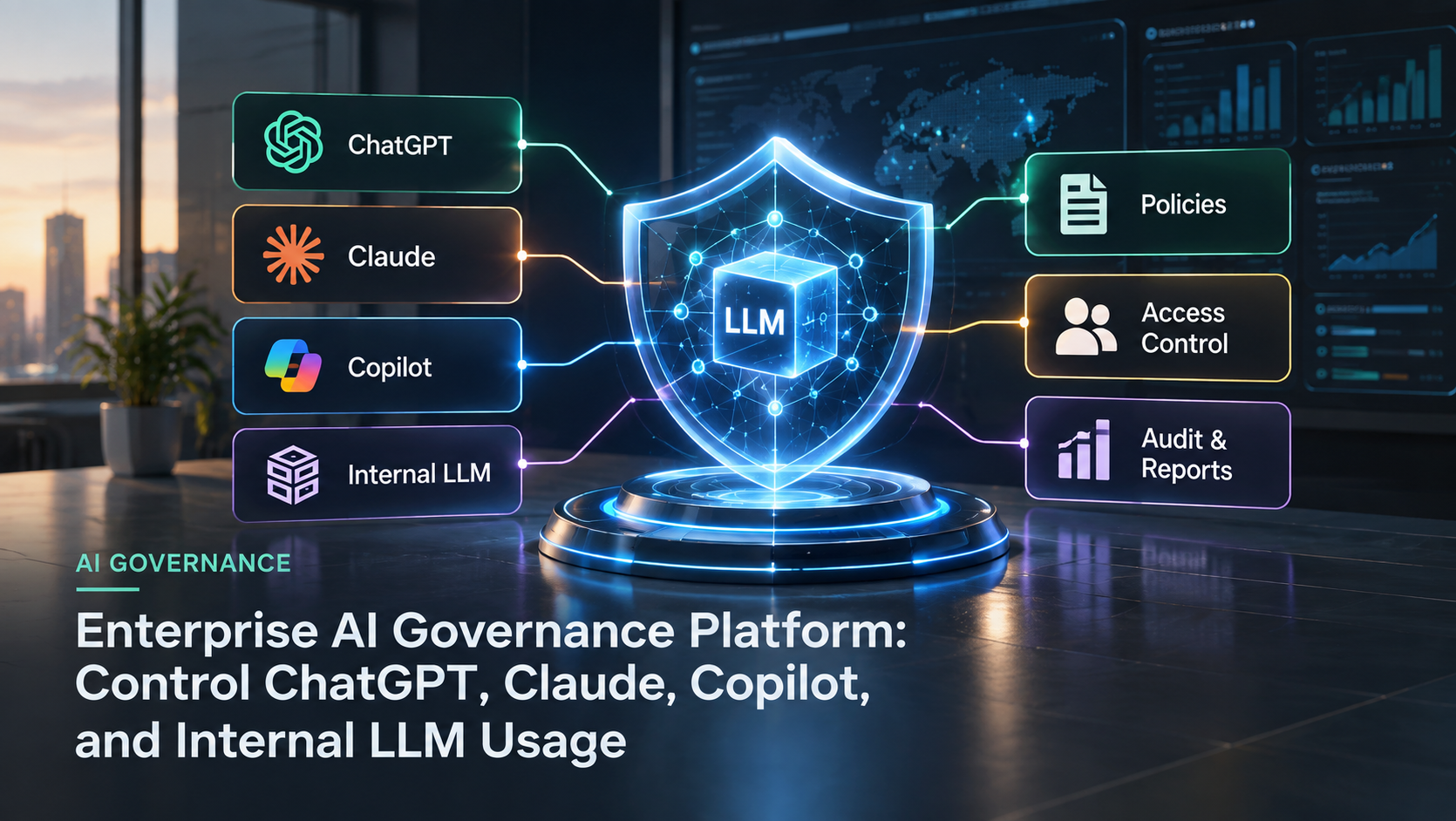
Enterprise AI Governance Platform: Control ChatGPT, Claude, Copilot, and Internal LLM Usage
Employees are already using ChatGPT, Claude and Copilot. A governance platform is the control layer that masks data, enforces policy, controls access by role, and produces audit-ready evidence across every model.

On this page›
What Is an Enterprise AI Governance Platform?
Your employees are already using ChatGPT, Claude, Microsoft Copilot, and a dozen other AI tools. Most of them are doing it without formal approval, without policy guardrails, and without any audit trail. According to Deloitte's 2026 AI governance research, only 25% of organizations have comprehensive visibility into how employees use AI. The other 75% are operating blind.
That is the problem an enterprise AI governance platform is built to solve.
Direct answer: An enterprise AI governance platform is the control layer that monitors, controls, and secures how employees and applications interact with AI tools, including public models like ChatGPT and Claude, enterprise copilots like Microsoft Copilot, cloud APIs like Azure OpenAI and AWS Bedrock, and internal LLMs. It enforces policy, masks sensitive data before it reaches the model, controls access by role, logs every interaction, and produces compliance-ready audit evidence.
Governance is not AI security by another name. Security addresses threats from the outside. Governance addresses risk from the inside: the employee who pastes customer PII into ChatGPT, the team using an unapproved model, the incident your legal team cannot reconstruct because there is no log.
Three things to know before evaluating any platform:
- Governance spans the full AI stack, from public LLMs to private models to internal copilots, not just one environment.
- Gartner estimates AI governance platform spending at $492 million in 2026, making this an established, budgeted control category.
- Only 20% of companies have a mature governance model for autonomous AI agents, per Deloitte, meaning most organizations are behind where they need to be.
Why Enterprises Need AI Governance Now
AI adoption has moved faster than governance programs can track. Optro.ai's 2026 data shows 85% of organizations are integrating AI into core operations. Formal AI governance guidance has risen from 52% to 76% of organizations in a single year, per Conversational Geek. But guidance is not the same as control. As Fortinet's research puts it directly: "AI adoption is outpacing both regulation and effective security controls, leaving organizations exposed to privacy violations and legal liability."
The gap is no longer something to prepare for later. It is already part of daily operations.
The tools employees use are already ahead of the policies that cover them. Shadow AI is not a theoretical concern. It is the default state for most enterprises without a governance layer in place.
Regulatory pressure is compounding the urgency. The EU AI Act implementation timeline has created hard deadlines that compliance and legal teams cannot defer:
| Milestone | Date |
|---|---|
| AI prohibitions and literacy obligations | February 2, 2025 |
| General-purpose AI (GPAI) governance rules | August 2, 2025 |
| Article 50 transparency obligations | August 2, 2026 |
| High-risk AI system obligations | December 2027 / August 2028 |
Article 50 is already live. Organizations that deploy AI-powered systems without labeling, user-facing transparency, and documented oversight are now operating outside the regulation. That is not a future compliance problem. It is a current one. Our EU AI Act compliance guide breaks the obligations down article by article.
Common Risks from Employee AI Usage
When employees use AI tools without governance controls, the risk is not abstract. It is measurable. Organizations face an average of 223 GenAI-related data policy violations per month, according to Netskope-linked research. Grip Security's 2026 report found that 80% of SaaS and AI incidents involve sensitive data, and that AI-related policy violations more than doubled year over year.
The Cloud Security Alliance says conventional security frameworks do not fully cover model manipulation, data poisoning, bias, or supply-chain risk. In plain terms, standard security tooling was not built for this job.
Here is where the risk actually lives:
| Risk | How It Happens | Business Impact | Control Needed |
|---|---|---|---|
| Sensitive data leakage | Employees paste customer PII, financial data, legal documents, or source code into external AI tools | Regulatory breach, client trust damage, GDPR or HIPAA exposure | PII masking before prompt leaves the boundary |
| Shadow AI and unapproved models | Teams adopt AI tools outside IT and security review | Policy gaps, identity sprawl, no visibility into what data was shared | RBAC, model allowlisting, usage monitoring |
| Missing audit trails | AI interactions are not logged or retained | Cannot reconstruct incidents, respond to investigations, or produce compliance evidence | Immutable interaction logs with full prompt and response capture |
| Regulatory exposure | No AI inventory, no risk classification, no documented controls | Fails EU AI Act Article 50, GDPR accountability obligations, and audit requirements | Compliance reporting, automated evidence generation |
34% of organizations identify sensitive data exposure as their top concern tied to employee AI usage, per Aona.ai. That concern is well-founded: 55% of employees are already using unapproved AI tools, and 35% of organizations describe shadow AI as pervasive. Automatic data classification and masking with Walled Redact address the leakage path directly.
Core Capabilities Buyers Should Expect
Most AI security tools address a slice of the problem: prompt injection defense, output filtering, or model monitoring. A true enterprise AI governance platform covers the full control plane. The distinction matters when you are evaluating vendors.
Kosmoy's 2026 analysis of leading platforms found that "the strongest offerings for EU AI Act readiness emphasize framework mapping, evidence collection, and audit-ready documentation rather than just model monitoring." That is a useful filter. If a vendor leads with threat detection and cannot show you a compliance report, you are looking at a security tool, not a governance platform.
Use this checklist when evaluating vendors:
| Capability | Why It Matters | What to Ask Vendors |
|---|---|---|
| PII masking | Prevents sensitive data from reaching external models before the prompt is sent | Does masking happen in real time, before the prompt leaves your environment? Is it reversible in the response? |
| Policy enforcement | Translates acceptable-use rules into technical controls, not just documentation | Can policies be scoped by user, group, department, and model? What happens when a policy is violated? |
| Prompt inspection | Detects prompt injection, jailbreak attempts, and policy-violating content at the input layer | Is inspection applied to both prompts and outputs? What is the latency impact? |
| Role-based access control (RBAC) | Limits which users can access which models and under what conditions | Can RBAC be enforced at the individual user, team, and application level across all connected models? |
| Immutable audit logs | Creates a tamper-resistant record of every AI interaction for incident response and compliance evidence | Are logs searchable? How long are they retained? Can they be exported to your SIEM? |
| SIEM integration | Connects AI governance data to your existing security operations workflow | Which SIEM platforms are supported? Is integration native or requires custom connectors? |
| Multi-model governance | Applies consistent policy across ChatGPT, Claude, Copilot, Azure OpenAI, Bedrock, and internal LLMs | Does the platform govern all model types from a single control plane, or does each model require separate configuration? |
| Compliance reporting | Produces audit-ready documentation for EU AI Act, GDPR, MAS TRM, and other frameworks | Which regulatory frameworks are supported? Is reporting automated or manual? |
The strongest platforms enable safe AI adoption. They do not force a block-everything posture. The goal is to give employees access to AI tools while keeping data, policy, and audit evidence under organizational control. See how we map these controls on our NIST AI RMF page.
Public LLMs vs Private LLMs vs Enterprise Copilots
A common mistake in governance planning is treating each AI environment as a separate problem. It is not. The governance requirements, policy enforcement, access control, logging, and compliance evidence, apply across all of them. The model type changes the risk profile, not the need for control.
As Matillion frames it: "Public LLMs behave like shared utilities; private LLMs behave like owned systems." Clairo adds the sharper point: "The real difference is not AI capability, but data fate." Where does your data go, who can access it, and can you prove what happened to it?
| Model Type | Examples | Data Control | Governance Priority |
|---|---|---|---|
| Public LLMs | ChatGPT, Claude, Gemini | Low: data crosses third-party boundaries | PII masking, prompt inspection, usage logging, policy enforcement |
| Cloud AI APIs | Azure OpenAI, AWS Bedrock | Medium: data stays within cloud contracts, but still leaves your perimeter | RBAC, audit logs, output validation, compliance reporting |
| Enterprise copilots | Microsoft Copilot, GitHub Copilot | Medium-high: approved environments, but not automatically compliant | Policy scoping, interaction logging, access controls by role |
| Private / internal LLMs | Self-hosted models, fine-tuned models | High: data stays on-premises, but governance is still required | Prompt and output logging, access control, policy enforcement, audit trails |
The governance platform must span all four. A platform that only governs public LLMs leaves your Azure OpenAI and internal model usage completely uncontrolled.
How WalledAI Supports Enterprise AI Governance
If the checklist above sounds familiar, WalledAI is built to cover that problem across every model your organization uses.
WalledAI sits between your employees, your applications, and any LLM: ChatGPT, Claude, Microsoft Copilot, Azure OpenAI, AWS Bedrock, or internal models. Every prompt is intercepted before it reaches the model. Every response is inspected before it reaches the user. The entire interaction is logged.
What WalledAI delivers against the buyer checklist
- PII masking: Sensitive data is masked before the prompt leaves your boundary, then restored in the response. Employees get full AI productivity. Your data never crosses the boundary in raw form. See Walled Redact.
- Real-time policy enforcement: Policies are enforced at the prompt and output layer, scoped by user, group, department, and model, with sub-30ms latency.
- RBAC: Access to specific models and capabilities is controlled at the user, team, and application level from a single control plane via Enterprise RBAC.
- Immutable audit logs: Every interaction is logged and searchable in the governance dashboard. Legal, compliance, and security teams can reconstruct any AI session.
- SIEM integration: Governance data feeds directly into your existing security operations stack.
- Automated compliance reporting: WalledAI produces audit-ready documentation for the EU AI Act, MAS TRM, and other regulatory frameworks, without manual evidence collection.
- Sovereign deployment: Full on-premises architecture. Your data never leaves your environment.
This is not a cloud-first product retrofitted for enterprise. WalledAI is built from the ground up for organizations that need data sovereignty, regulatory defensibility, and governance across every model in their stack.
If your organization needs to govern AI usage across public LLMs, cloud APIs, enterprise copilots, and internal models from a single control plane, explore enterprise AI governance or book a demo with WalledAI.
Buyer Checklist and FAQs
Shortlist checklist for enterprise AI governance vendors
Before signing with any platform, confirm it can answer yes to each of these:
- Does it govern all model types from a single control plane: public LLMs, cloud APIs, enterprise copilots, and internal models?
- Does PII masking happen in real time, before the prompt leaves your environment?
- Can policies be scoped by user, group, department, and model?
- Are audit logs immutable, searchable, and exportable to your SIEM?
- Does it produce automated compliance reports for EU AI Act, GDPR, or MAS TRM?
- Can it be deployed on-premises for full data sovereignty?
- Does it maintain sub-100ms latency so governance does not degrade employee productivity?
Any vendor that cannot answer yes to all seven is a point solution, not a governance platform. Sector-specific buyers can go deeper with AI governance for financial services or AI governance for technology companies.
Frequently asked questions
What does an enterprise AI governance platform do? It monitors, controls, and secures how employees and applications use AI tools. Core functions include PII masking, policy enforcement, RBAC, immutable audit logs, and compliance reporting across public LLMs, cloud AI APIs, enterprise copilots, and internal models.
How is AI governance different from AI security? AI security addresses external threats: model attacks, adversarial inputs, and infrastructure vulnerabilities. AI governance addresses internal risk: what your employees are doing with AI tools, whether it complies with policy, and whether you can prove it. You need both, but they are not the same problem.
How do companies govern ChatGPT, Claude, and Copilot usage? A governance platform intercepts prompts before they reach the model, enforces policy in real time, masks sensitive data, and logs every interaction. This applies consistent controls across all models rather than managing each tool separately.
What controls are needed for enterprise LLM governance? At minimum: PII masking, policy enforcement, RBAC, immutable audit logs, SIEM integration, and compliance reporting. Multi-model coverage is non-negotiable for enterprises running more than one AI tool.
Why do regulated companies need AI governance? The EU AI Act's Article 50 transparency obligations are already in force as of August 2, 2026. GDPR accountability requirements apply to AI-processed personal data. MAS TRM covers AI usage in financial services. Regulated companies need documented controls, audit trails, and evidence of oversight, or they are non-compliant.
What is the difference between an LLM gateway and an AI governance platform? An LLM gateway routes traffic between applications and models. A governance platform enforces policy, masks data, controls access by role, logs interactions, and produces compliance evidence. A gateway is infrastructure. A governance platform is a control plane.
Ready to govern AI usage across your entire model stack? Book a demo with WalledAI and see how enterprises are enabling ChatGPT, Claude, Copilot, Azure OpenAI, Bedrock, and internal LLMs without sacrificing data control, auditability, or compliance readiness.
Get audit-ready before August 2026.
See how WalledAI operationalises Articles 9–15 and Article 50 obligations as a runtime governance layer.