AI Governance Framework: 10 Patterns That Actually Work
Policy documents do not stop a prompt. This guide sets out ten implementation patterns - interception, classification, masking, policy decision points, evidence capture - and maps each one to the regulatory obligation it satisfies.

On this page›
- Why Governance Frameworks Fail in Implementation
- The Reference Architecture: Five Planes
- Pattern 1: Universal Interception Point
- Pattern 2: Purpose-Bound Identity
- Pattern 3: Classify Before You Decide
- Pattern 4: Reversible Masking Instead of Blocking
- Pattern 5: Externalised Policy Decision Point
- Pattern 6: Symmetric Output Inspection
- Pattern 7: Graded Human Oversight
- Pattern 8: Evidence as a First-Class Output
- Pattern 9: Model Registry and Routing
- Pattern 10: Explicit Degradation Behaviour
- Mapping Patterns to Regulatory Obligations
- A Sequenced Implementation Path
- Frequently Asked Questions
Direct answer: An AI governance framework design pattern is a reusable technical arrangement - a control, its placement in the request path, and its evidence output - that turns a written policy obligation into something the runtime enforces. The ten patterns below cover interception, identity, classification, masking, policy decision, output inspection, human oversight, evidence capture, model registry, and degradation behaviour. Each maps to a specific clause in NIST AI RMF, ISO/IEC 42001, or the EU AI Act.
Why Governance Frameworks Fail in Implementation
Most enterprise AI governance programs start as a document: an acceptable-use policy, a risk register, a committee charter. None of those artefacts sit in the request path. When an analyst pastes a client contract into a chat window, the policy is not consulted, the risk register is not updated, and the committee finds out in the incident review.
The gap is architectural rather than organisational. NIST AI RMF describes functions (Govern, Map, Measure, Manage) but deliberately leaves implementation open. ISO/IEC 42001 specifies an AI management system, not a reference architecture. Design patterns fill that space: they name the concrete control, say where it belongs, and describe what breaks when it is missing.
This guide is deliberately implementation-heavy. Every pattern below has a placement, a failure mode, and an evidence artefact. If a pattern in your architecture produces no evidence, you have a control you cannot prove during an audit.
The Reference Architecture: Five Planes
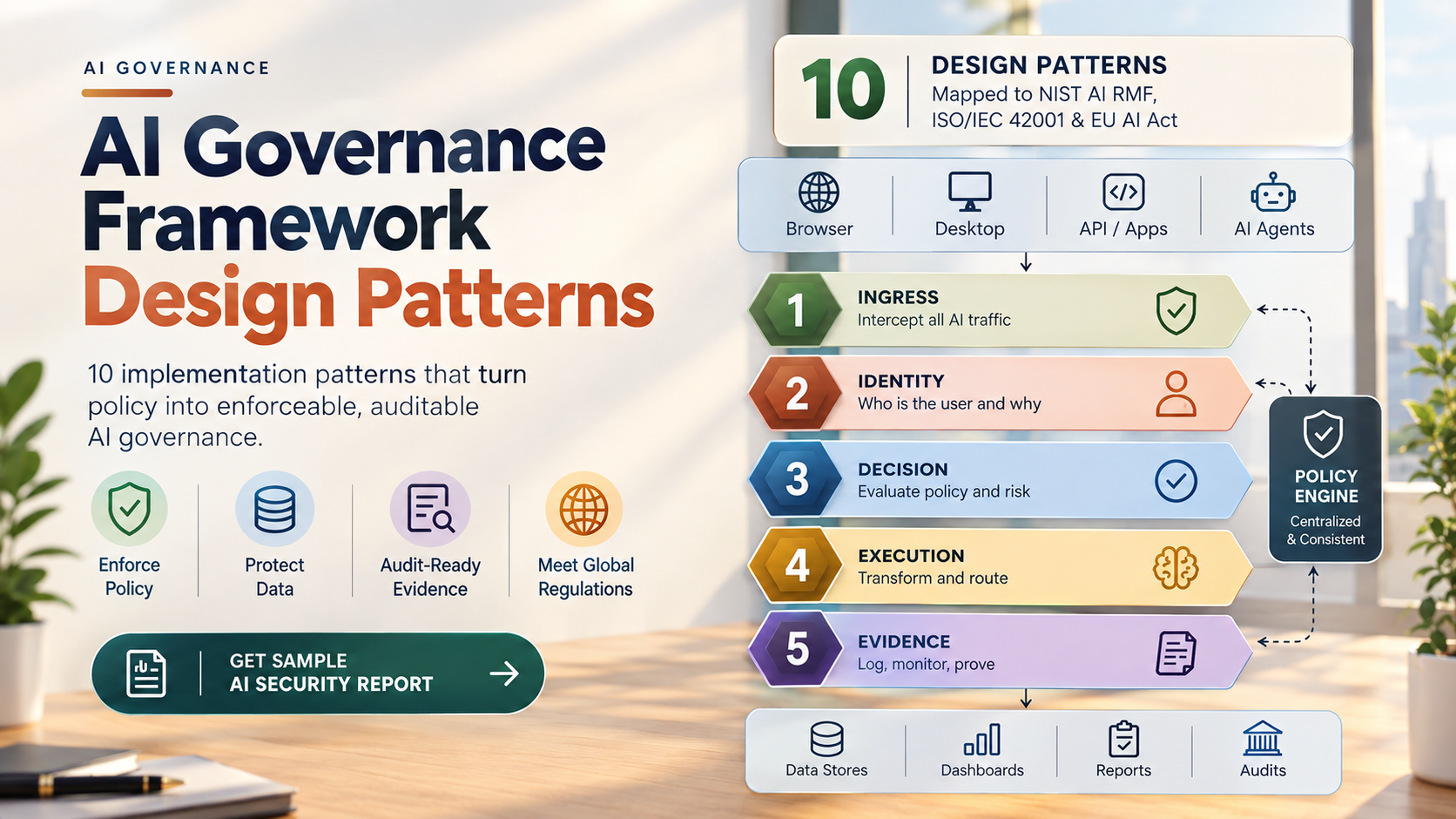
Every pattern here lands in one of five planes. Naming the planes first makes control placement unambiguous.
| Plane | Responsibility | Latency Budget | Typical Owner |
|---|---|---|---|
| Ingress | Capture the interaction before it leaves the trust boundary: browser extension, proxy, SDK, or gateway | Sub-10 ms | Platform engineering |
| Identity | Resolve the caller to a user, group, service principal, and purpose | Cached, sub-5 ms | IAM |
| Decision | Evaluate policy: allow, mask, redact, route, block, or escalate | 10-50 ms | Security and risk |
| Execution | Transform the payload and call the model or an approved substitute | Model-bound | AI platform |
| Evidence | Write immutable records, metrics, and compliance artefacts | Asynchronous | Compliance and SecOps |
A framework that skips the Decision plane is monitoring, not governance. A framework that skips the Evidence plane is enforcement you cannot defend.
Pattern 1: Universal Interception Point
Problem. Controls implemented per-application never reach the tools employees actually use. The browser is where most shadow AI happens.
Pattern. Place a single interception layer that all AI traffic crosses, regardless of client: browser extension for SaaS chat interfaces, forward proxy for desktop clients, and an API-compatible gateway for applications and agents. All three feed one policy engine.
Anti-pattern. One connector per model provider. Policy drifts between connectors within a quarter and no one can answer "what rule applied to this request?".
Failure mode. Unmanaged devices and personal accounts bypass the proxy. Pair interception with network egress rules that deny direct model endpoints from managed networks.
Evidence. Coverage ratio: intercepted AI sessions over total detected AI sessions. Auditors ask for this number before anything else. Our governance dashboard reports it per department.
Pattern 2: Purpose-Bound Identity
Problem. Identity alone is insufficient. The same lawyer may legitimately send a contract to an internal model and illegitimately send it to a public one.
Pattern. Resolve every request to a tuple of (principal, group, model, data class, purpose) and make policy a function of the tuple rather than the user alone. Purpose can be inferred from application context, workspace, or an explicit selector.
Implementation note. Cache the identity resolution but never the authorisation decision - group membership changes must take effect on the next request, not the next cache expiry. Role-based access control belongs at this layer, not inside individual applications.
Regulatory mapping. EU AI Act Article 26 deployer obligations assume you can name who operated the system and in what role.
Pattern 3: Classify Before You Decide
Problem. A policy engine that cannot see data sensitivity can only make binary allow or block decisions, which drives users to unmanaged tools.
Pattern. Run classification synchronously in the Decision plane and attach the resulting labels to the request context. Use a layered detector: deterministic patterns for structured identifiers, dictionary and gazetteer matching for internal entity names, and a model-based detector for free-text sensitivity that patterns miss.
Tuning rule. Optimise for recall on high-severity classes and precision on low-severity ones. A false negative on a national ID is a breach; a false positive on a project codename is friction.
Evidence. Per-class detection counts and reviewer overrides. Automatic data classification writes both.
Pattern 4: Reversible Masking Instead of Blocking
Problem. Blocking sensitive prompts destroys the utility that drove adoption, and users route around it.
Pattern. Substitute detected entities with stable, type-preserving placeholders before egress, keep the mapping inside the trust boundary, and re-substitute on the response path. The external model receives structure without identity.
| Stage | Payload |
|---|---|
| User prompt | Summarise the dispute between Acme Pte Ltd and Jane Tan, NRIC S1234567D. |
| Sent to model | Summarise the dispute between [ORG_1] and [PERSON_1], [NATIONAL_ID_1]. |
| Model output | [ORG_1] alleges that [PERSON_1] breached clause 7... |
| Returned to user | Acme Pte Ltd alleges that Jane Tan breached clause 7... |
Design constraints. Placeholders must be type-preserving so the model reasons correctly, stable within a session so co-reference survives, and unique across sessions so mappings cannot be correlated. The mapping store is itself sensitive: encrypt it, scope it to the session, and expire it aggressively.
Failure mode. Entities split across token boundaries or embedded in code blocks. Mask on normalised text, not raw markdown. Walled Redact implements this pattern end to end.
Pattern 5: Externalised Policy Decision Point
Problem. Rules encoded in application code cannot be reviewed by risk owners or changed without a release.
Pattern. Separate the policy decision point from the enforcement point. Enforcement lives in the request path; decision logic lives in a versioned, declaratively expressed policy set that risk owners can read. Every decision returns an outcome plus the rule identifier that produced it.
Implementation note. Version policies like code and record the policy version on each decision record. Without it, you cannot reconstruct why a request was allowed six months ago - which is precisely the question an investigation asks.
Regulatory mapping. ISO/IEC 42001 change control and NIST AI RMF Govern 1.2 both expect documented, reviewable control changes rather than tacit engineering decisions.
Pattern 6: Symmetric Output Inspection
Problem. Most deployments inspect prompts and trust responses. Exfiltration, unsafe content, and injected instructions arrive on the response path.
Pattern. Apply inspection symmetrically. On the response, check for leaked secrets, unsafe content classes, instruction-injection markers from retrieved documents, and unsupported factual claims where the answer is grounded in enterprise sources.
Latency management. Stream to the user only after a first-pass classifier clears the buffer, and run expensive verification asynchronously with the ability to retract or annotate. Walled Protect handles adversarial input, and Walled Correct handles grounding on the output side.
Pattern 7: Graded Human Oversight
Problem. "Human in the loop" applied uniformly is either theatre or a bottleneck.
Pattern. Grade oversight by decision consequence, not by model. Three tiers work in practice:
| Tier | Trigger | Control |
|---|---|---|
| Informational | Drafting, summarising, internal exploration | Log and sample-review |
| Advisory | Output informs a decision affecting a customer or employee | Named reviewer acknowledgement recorded with the output |
| Consequential | Output triggers an action with legal or financial effect | Blocking approval with reviewer identity, timestamp, and rationale |
Regulatory mapping. EU AI Act Article 14 requires that oversight be effective, meaning the reviewer has the information and authority to intervene. Recording the acknowledgement is what makes the requirement demonstrable. Our EU AI Act compliance page covers the deployer-side obligations in detail.
Pattern 8: Evidence as a First-Class Output
Problem. Logs designed for debugging do not satisfy auditors, and logs designed after the fact cannot be backfilled.
Pattern. Treat the evidence record as a product of every interaction, with a fixed schema: request identifier, principal, model, policy version, decision, detected data classes, masking applied, oversight tier, reviewer, and content hashes. Store append-only with retention aligned to the longest applicable obligation.
Design constraint. Evidence must be useful without being a second copy of the sensitive data. Store hashes and class labels by default; store raw content only where regulation requires it and access is separately controlled.
Failure mode. Retention set by storage cost rather than obligation. Decide retention per framework - see our NIST AI RMF mapping - then size storage.
Pattern 9: Model Registry and Routing
Problem. Governance applied to a fixed list of models breaks the week a new one launches.
Pattern. Maintain a registry where each model carries attributes: hosting location, data-retention terms, approved data classes, and risk tier. Route by attribute rather than by name, so a new model inherits policy the moment it is registered and unregistered models fall to a default-deny path.
Sovereignty note. Hosting location is a routing attribute, not a footnote. Regulated workloads should resolve to on-premises, private-cloud, or air-gapped deployments through the same mechanism that governs public models.
Pattern 10: Explicit Degradation Behaviour
Problem. Undefined behaviour when a control is unavailable becomes fail-open behaviour under load.
Pattern. Define, per data class, what happens when the classifier, policy service, or mapping store is unavailable. Fail closed for regulated classes and fail open with elevated logging for unclassified internal use. Publish the behaviour so incident responders and auditors are not guessing.
Test requirement. Exercise degradation deliberately in pre-production. A control whose failure path has never been executed is an assumption.
Mapping Patterns to Regulatory Obligations
The reason to implement patterns rather than ad-hoc controls is traceability: each pattern should discharge a named obligation and emit the artefact that proves it.
| Pattern | Primary obligation | Evidence artefact |
|---|---|---|
| Universal interception | NIST AI RMF Map 1 - context and inventory | Coverage ratio and AI system inventory |
| Purpose-bound identity | EU AI Act Art. 26 - deployer responsibilities | Per-interaction principal and role record |
| Classification | GDPR Art. 5, PDPA obligations | Data-class detection log |
| Reversible masking | Data minimisation on cross-border transfer | Masking events with class and count |
| Externalised policy | ISO/IEC 42001 change control | Versioned policy set and decision references |
| Output inspection | NIST AI RMF Measure 2 - trustworthiness | Blocked and annotated output records |
| Graded oversight | EU AI Act Art. 14 - human oversight | Reviewer acknowledgements with rationale |
| Evidence capture | ISO/IEC 42001 Cl. 9, audit readiness | Append-only interaction ledger |
| Model registry | EU AI Act GPAI transparency, procurement due diligence | Registry with attributes and approval state |
| Degradation behaviour | NIST AI RMF Manage 4 - incident response | Documented and tested failure paths |
A Sequenced Implementation Path
Attempting all ten patterns at once stalls. The order below front-loads the patterns that produce evidence early, because evidence is what unlocks budget for the rest.
- Weeks 1-4: Interception and evidence capture in observe-only mode. You now have an AI inventory and a coverage number.
- Weeks 5-8: Classification in shadow mode. Measure detection rates before anyone is blocked.
- Weeks 9-12: Masking on the highest-severity classes only, with reversal on the response path.
- Weeks 13-16: Externalised policy plus purpose-bound identity, replacing the hard-coded rules from the earlier phases.
- Weeks 17-20: Output inspection, graded oversight, model registry, and tested degradation paths.
Each phase ships a control and its artefact together. If a phase produces no artefact, it has not shipped. For the wider platform view, see our enterprise AI governance platform guide and the responsible AI approach these patterns implement.
Frequently Asked Questions
What is an AI governance framework design pattern?
It is a reusable arrangement of a control, its placement in the AI request path, and the evidence it produces. Patterns turn framework language such as "ensure human oversight" into an implementable component with a defined failure mode.
Where should governance controls sit - in the application or the network?
Enforcement belongs at a shared interception layer that all clients cross, while decision logic belongs in an externalised, versioned policy service. Controls embedded in individual applications drift and cannot be evidenced consistently.
How do these patterns map to NIST AI RMF and ISO/IEC 42001?
NIST AI RMF describes outcomes across Govern, Map, Measure, and Manage; ISO/IEC 42001 specifies a management system. The patterns supply the technical layer both assume: interception and registry satisfy inventory, classification and masking satisfy data controls, evidence capture satisfies audit, and degradation behaviour satisfies incident management.
Does masking degrade model output quality?
Type-preserving, session-stable placeholders keep grammatical and referential structure intact, so summarisation, drafting, and analysis tasks are largely unaffected. Tasks that depend on real-world knowledge of the specific entity are the exception and should be routed to an internal model instead.
What should be built first?
Interception with evidence capture in observe-only mode. It is the lowest-friction change, it produces the inventory and coverage metrics every framework asks for, and it gives you baseline data before you enforce anything.
Get audit-ready before August 2026.
See how WalledAI operationalises Articles 9–15 and Article 50 obligations as a runtime governance layer.