AI Watermarking Explained: How Claude's Watermark Works and What It Misses
Claude's new watermark is a regulatory compliance signal, not an enterprise governance control. Here's how it works, how easily it's evaded, and what deployers actually owe under Article 50.

On this page›
- How Claude's Watermarking Actually Works
- The Evasion Problem: Four Cents and a Paraphrase
- What Researchers and Practitioners Are Actually Saying
- What EU AI Act Article 50 Actually Requires of Enterprises
- Watermarking vs. Governance: The Controls That Actually Matter
- The Broader Watermarking Landscape: Claude Is Not Alone
- What Enterprises Should Do Now
- Frequently Asked Questions About Claude's Watermarking
EU AI Act Article 50 | Last reviewed: August 2026
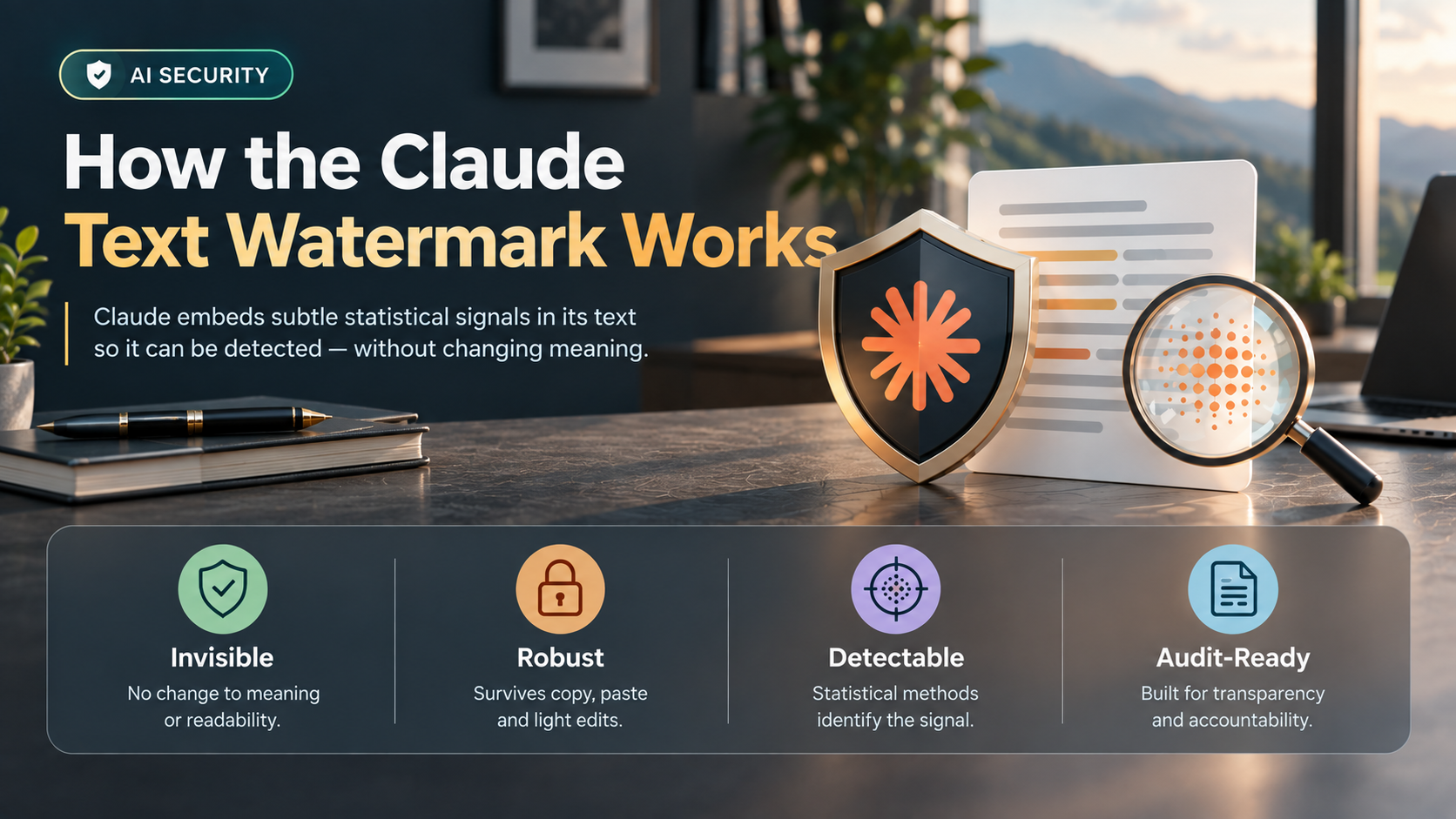
Quick answer: Claude now embeds an imperceptible statistical watermark in the text it generates and attaches signed C2PA provenance metadata to generated image files, in response to EU AI Act Article 50 transparency obligations that began applying on 2 August 2026. The watermark is a regulatory compliance signal: it indicates Claude may have processed a piece of content. It is not an enterprise governance control - it says nothing about who prompted the model, what data they shared with it, or whether the output is safe, and independent research shows it can be stripped by a single paraphrase pass. Enterprises deploying Claude have separate, narrower obligations as deployers under Article 50(4), and still need their own input-layer governance regardless of what the model provider watermarks on the way out.
Claude now watermarks every text output it produces. That mark is a regulatory compliance signal, not an enterprise governance control. Understanding the difference will determine whether your AI governance program is real or just a checkbox.
On 2 August 2026, EU AI Act Article 50 transparency obligations began applying, requiring providers of generative AI systems to mark AI-generated content in a machine-readable format detectable as artificially generated. Anthropic responded by publishing its official watermarking commitment, confirming that Claude models launched on or after 2 August 2026 embed imperceptible watermarks in generated text and attach signed provenance metadata to supported file types. Violations of Article 50 can be subject to administrative fines under Article 99 of up to €15 million or 3% of worldwide annual turnover, subject to the regulation's proportionality rules and Member State enforcement.
The watermark tells you Claude may have processed the content. It tells you nothing about who prompted it, what data they shared with it, whether sensitive information left your environment, or whether the output is safe.
That gap is where enterprise risk lives. A watermark is provenance telemetry. It looks backward at what the model produced. The controls that protect your organisation operate at the input layer and look forward at what your employees are sending. Those are different problems, and confusing them is exactly how compliance teams end up with a false sense of security.
Within days of Anthropic's rollout, security researchers began analysing how the mark behaves under adversarial conditions. A TechTimes investigation estimated that a single paraphrase pass could cost roughly four cents per 1,000 words at current API rates - an illustrative figure that captures how economically trivial systematic evasion becomes once a public detection endpoint exists.
This article breaks down exactly what Claude's watermarking does and does not do: how the mechanism works technically, why evasion is structurally easier than detection, what Article 50 actually requires of enterprises deploying Claude as opposed to Anthropic building it, and what real governance looks like beyond the watermark.
How Claude's Watermarking Actually Works
Claude's watermarking system operates on two parallel tracks: statistical text watermarking for all generated prose, and C2PA cryptographic metadata for supported file types. Understanding both is necessary to evaluate what the system actually guarantees.
Statistical Text Watermarking
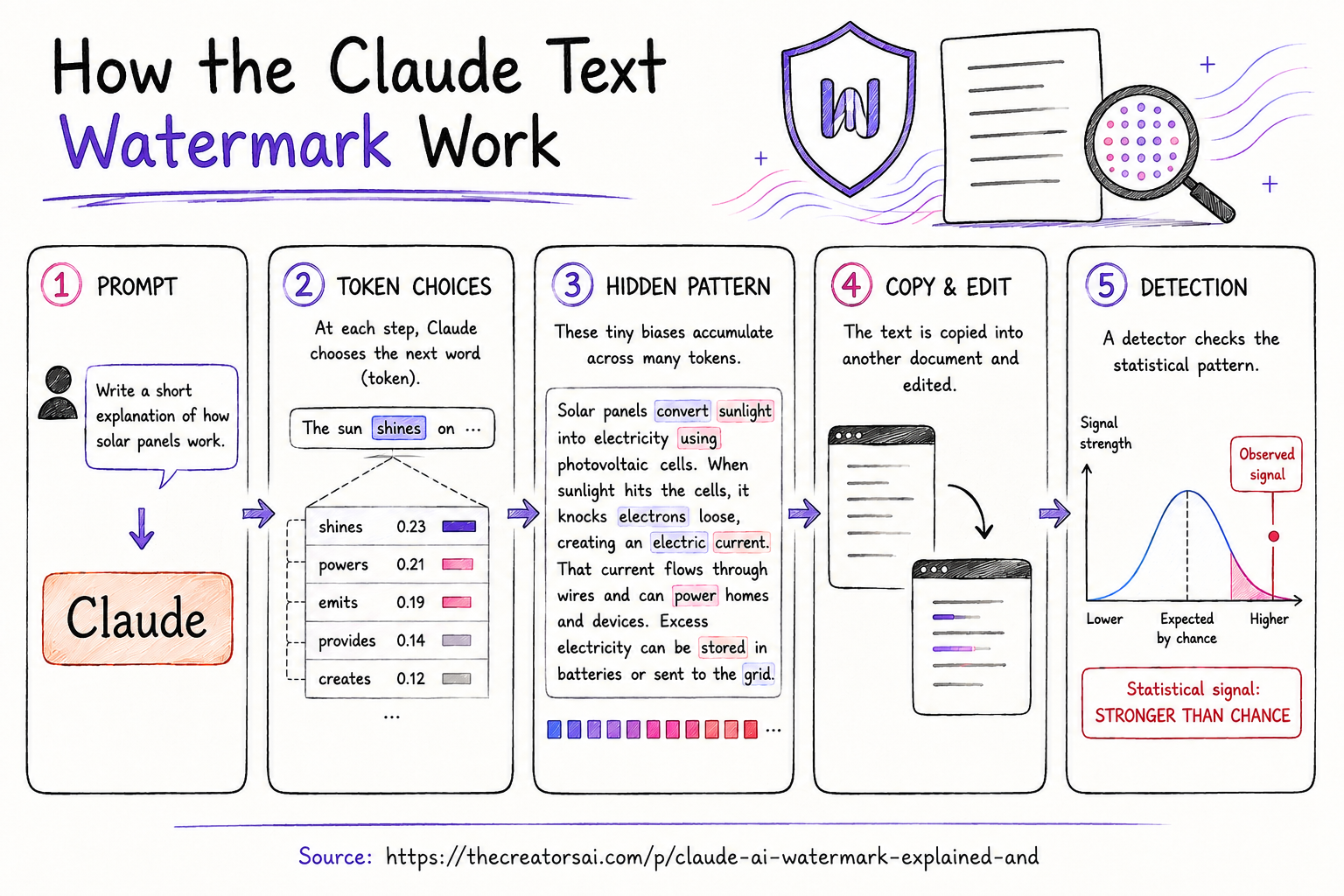
Anthropic has not publicly disclosed the full technical specification of Claude's text watermark. Its documentation describes an inference-time, imperceptible watermark embedded directly into generated text. The mechanism is consistent with the broader family of statistical text-watermarking approaches, where token selection is subtly constrained to create a detectable statistical pattern. It would be premature to describe Claude's implementation as SynthID, KGW, or any other specific published scheme until Anthropic releases more detail.
Machine learning researcher Sebastian Raschka offered a clear lay explanation of the mechanism: "When we are generating tokens, there can be multiple high-scoring tokens at certain next-word positions. With watermarking, there is a key that says which of the (ideally equally) highest-scoring tokens to select. Or, more concretely, the secret key and previous token influence the randomness here. Now, if we repeat this at many token positions, this creates the watermark as it will be a pattern that is statistically unlikely to get otherwise (due to combinatorics)."
Raschka also raised a pointed question that Anthropic has not publicly answered: the watermarking is an inference-time technique that requires no retraining, so Anthropic could, technically, apply it only to EU users. Applying it globally was a policy choice, not a technical necessity.
A few critical nuances from Anthropic's official documentation:
- The watermark indicates that Claude may have processed the content, not that a specific user authored it, and Anthropic's own guidance warns that the absence of a mark does not prove human authorship
- It is a probabilistic signal, not a binary yes/no. False positives and false negatives exist by design
- The Code of Practice gives short-form text proportionate treatment because reliability drops sharply for very short outputs
- Anthropic has not publicly disclosed a full technical spec that would let outside observers reliably infer which Claude model version, API key, or organisation generated the content from the watermark alone
C2PA Cryptographic Metadata
For generated image files, specifically .svg, .png, and .jpg, Claude attaches a C2PA content credential: a cryptographically signed manifest recording what created the content, when, and the provenance chain. Anthropic has not publicly confirmed C2PA support for PDF or other document formats. Unlike the statistical text watermark, C2PA metadata is verifiable offline without calling Anthropic's API.
The limitation: C2PA metadata can be lost or deliberately removed through transformations such as screenshots, copy-paste, format conversion, re-saving, or upload pipelines that strip provenance data. That makes it tamper-evident provenance, not tamper-proof provenance. The EU's own Code of Practice recommends a layered approach combining secured metadata and imperceptible watermarking as the core technical mechanisms. Fingerprinting and logging are addressed as additional optional mechanisms in the Code, not as universally mandated layers. The Code is also voluntary: it helps providers demonstrate compliance with the underlying legal obligation, but it is not itself law.
Key takeaway: Claude's watermarking system is technically well-constructed. But it was designed to satisfy a regulatory disclosure obligation, not to provide enterprise-grade content attribution or access control.
The Evasion Problem: Four Cents and a Paraphrase
The evasion concern surfaced almost immediately after Anthropic's rollout, and it is not about a single researcher finding a clever exploit. It is structural - built into the architecture of how the detection API must work.
When Anthropic confirmed on 12 August that a text detection API is in development, it resolved one open question and raised a harder one. An Anthropic engineer stated the company will ship "a text detection API that you can use yourself" - but pricing, rate limits, access controls, and SLA guarantees have not been announced. The EU AI Act's Code of Practice, which Anthropic signed, requires providers to support third-party detection of their marks. Once such an API is publicly accessible, it also becomes a potential evasion oracle: paraphrase, check, repeat until the mark disappears. At current frontier API rates, one paraphrase pass over a 1,000-word article is estimated to cost in the range of four cents - making systematic iteration economically trivial if a detection endpoint is freely accessible.
This is not a Claude-specific vulnerability. It is a structural property of all statistical text watermarking schemes - and the empirical data backs it up.
Why Paraphrase Attacks Are Unavoidable
The fundamental tension in text watermarking is well-documented in academic literature. A July 2026 forensic evaluation (arXiv 2607.16010) tested three leading watermark methods - KGW, Unigram, and the MarkLLM implementation of SynthID-Text - against meaning-preserving paraphrase across 846 runs. KGW and Unigram marks were removed in 100% of tested cases after a single paraphrase pass. The SynthID removal rate was 98.3%. These results demonstrate the vulnerability of existing statistical watermarking approaches to paraphrase attacks. They should not be interpreted as a measured attack success rate against Claude's specific implementation, which Anthropic has not publicly benchmarked. Earlier academic work on adaptive evolutionary paraphrase-based attacks had already established the underlying challenge: statistical watermarking faces a fundamental robustness-quality tradeoff. The bias required for reliable detection must alter token-selection statistics enough to remain measurable, while remaining subtle enough to preserve text quality and resist meaning-preserving transformations.
The practical attack surface for enterprises is significant:
| Attack Method | Approximate Cost | What We Know |
|---|---|---|
| Direct copy-paste | $0 | Text watermark generally persists; C2PA metadata may not survive all pipelines |
| Manual paraphrase | $0 (human time) | Anthropic says heavy editing may degrade the mark; extent not publicly benchmarked for Claude |
| LLM paraphrase pass | ~$0.04/1,000 words (illustrative estimate) | Independent research shows high removal rates against KGW, Unigram, and SynthID implementations; Claude-specific results not published |
| Format conversion | $0 | C2PA metadata (.svg, .png, .jpg) may be stripped; text watermark behaviour depends on pipeline |
| Screenshot + OCR | $0 | C2PA file metadata lost; text watermark survival through OCR not confirmed |
Note: the cost estimate and removal rates above reflect published research on other watermarking schemes and reported API pricing assumptions, not a confirmed attack against Claude's production watermark.
A Missing Watermark Does Not Mean Human-Written
This is the most important limitation for compliance and legal teams, and it is explicitly stated in Anthropic's own documentation. A Claude watermark may be absent because an older model was used, the text was heavily edited, it was paraphrased or translated, the passage is too short to carry a reliable signal, the file format does not support C2PA metadata, or the metadata was stripped in transit. None of these scenarios constitute evidence that a human wrote the content.
Organisations that treat a clean detection result as proof of human authorship are drawing an inference the system is not designed to support. The watermark is best understood as positive provenance evidence when detected, not a universal AI detector. Courts, HR departments, academic institutions, and compliance reviewers that act on a negative detection result without understanding this limitation are building decisions on a false premise.
What This Means for Enterprise Threat Modelling
The evasion research confirms what the academic literature has argued for years: statistical text watermarking is effective at satisfying a regulatory disclosure requirement, but it is not a reliable attribution mechanism for adversarial scenarios.
The threat model that watermarking addresses: a regulator or auditor wants to know if a piece of content was AI-generated. The watermark helps answer that question when the content has not been modified.
The threat model that watermarking does not address: an employee exfiltrates proprietary data through a Claude prompt, then paraphrases the output before sharing it externally. A bad actor uses Claude to generate disinformation, runs it through a paraphrase API, and publishes it. An insider submits AI-generated analysis to a compliance review without disclosure.
In all three scenarios, the watermark does not provide the session-level audit trail or input-side protection needed to investigate those scenarios. The content leaves no trace in your governance infrastructure.
What Researchers and Practitioners Are Actually Saying
The technical and practitioner community's reaction to Claude's watermarking rollout has been pointed. The consensus: the mechanism works as a regulatory compliance instrument and a passive provenance signal, but it does not hold up as a security or attribution control.
The Academic View: Broken by Design
Soheil Feizi, a computer science professor at the University of Maryland, has published widely cited research showing that current watermarking schemes lack reliability and that his team's testing broke every scheme it evaluated. That work went further than removal: it demonstrated spoofing attacks that inject a stolen or inferred watermark signature into human-written text, causing it to trigger a positive AI-detection result. The implication is significant. You cannot fully trust a positive result, and you cannot fully trust a negative one.
Scott Aaronson, who built part of the theoretical foundation for text watermarking while at OpenAI, has argued in public commentary that every detection method has ways to work around it - a position consistent with the academic literature on the robustness-quality tradeoff, though his remarks predate and concern watermarking generally rather than Claude's specific 2026 scheme. His framing still captures the practical ceiling: watermarking catches passive copy-paste. It is not designed to withstand a determined adversary who deliberately modifies the content.
The Practitioner View: Authorship vs. Assistance
Cat Casey, writing on LinkedIn, identified the attribution problem that enterprise teams will hit first in practice:
"AI detected does not necessarily mean AI generated. AI could have written it, helped with it, polished it, translated it or otherwise processed it. If the signal is there, you may be flagged without anyone knowing how much AI actually did. Those are very different things."
This is the conflation problem in concrete terms. A compliance analyst who drafts a report and then asks Claude to check the grammar will produce a watermarked document. A regulator or auditor who treats that watermark as evidence of AI authorship is drawing an inference the system does not support.
The Unanswered Question: Why Global?
Raschka's question about the global rollout has not received a public answer from Anthropic, and it matters operationally. If watermarking is an inference-time operation with no retraining requirement, a per-region flag would have been technically straightforward. Applying it globally means every Claude output worldwide now carries a mark, regardless of whether the jurisdiction requires it, and regardless of whether the deployer wants it. There is no API flag to disable it. For enterprises in jurisdictions where AI disclosure obligations are narrower or non-existent, they now carry a marked product by default.
What EU AI Act Article 50 Actually Requires of Enterprises
Most coverage of EU AI Act Article 50 focuses on what Anthropic, Google, and OpenAI must do as providers. The deployer obligations, which apply to any enterprise using these models, receive far less attention. That imbalance is a compliance risk.
Article 50 took effect 2 August 2026. Fines reach €15 million or 3% of global annual turnover. And critically, the regulation has extraterritorial reach: it can also apply to organisations established outside the EU where the output of an AI system is used in the Union, per Article 2 of the AI Act. "Content reaches EU audiences" is not the statutory test - the relevant trigger is whether the AI system's output is used in the Union.
Provider Obligations vs. Deployer Obligations
The distinction matters because your LLM provider (Anthropic, in this case) satisfies the provider-side obligation by embedding the watermark. That does not exhaust your deployer-side obligations.
Article 50 draws a precise line. Article 50(2) binds providers: they must ensure outputs are marked in a machine-readable format. Article 50(4) binds deployers in two specific scenarios: disclosing deepfakes (image, audio, or video), and disclosing AI-generated or AI-manipulated text published with the purpose of informing the public on matters of public interest - subject to exceptions where the content has undergone human review or editorial control and a natural or legal person holds editorial responsibility. It is not a blanket obligation to label every Claude response. An employee using Claude internally to summarise a document has no Article 50(4) disclosure duty simply because Claude was used.
| Obligation | Who It Falls On | What Article 50 Actually Says |
|---|---|---|
| Mark AI-generated content at inference time | Provider (Anthropic) | Article 50(2): watermark embedded in outputs |
| Disclose deepfakes to audiences | Deployer (your organisation) | Article 50(4): disclosure required for synthetic image, audio, or video |
| Disclose AI-generated text on matters of public interest | Deployer (your organisation) | Article 50(4): applies when text is published to inform the public; exceptions for human editorial review |
| Inform users they are interacting with an AI system | Provider (your organisation, if you build the interface) | Article 50(1): applies to AI systems designed to interact directly with natural persons |
What Article 50 does not require of deployers: universal disclosure of every AI-generated output, write-once audit logs accessible to regulators, or mandatory preservation of C2PA manifests through your pipeline. Those may be best practices or obligations under other frameworks, but they are not Article 50 requirements.
The grace period distinction: transitional provisions apply to Article 50(2) provider marking for systems already on the market before 2 August. The deployer disclosure obligations under Article 50(4) applied from 2 August with no equivalent grace period for the deepfake disclosure duty.
What "Technically Feasible" Actually Means
Article 50 requires marking to be "effective, interoperable, robust and reliable as far as technically feasible." The regulation names no specific technology. Regulators will evaluate whether your chosen approach genuinely satisfies those criteria, not merely whether you checked a box.
The EU's Code of Practice, finalised 10 June 2026, describes a layered approach using digitally signed metadata combined with imperceptible watermarking as the core technical mechanisms for providers. Fingerprinting and logging are addressed as additional optional mechanisms in the Code, not as universally mandated layers. The Code is also voluntary: it helps providers demonstrate compliance with the underlying legal obligation, but it is not itself law. Anthropic appears on the Commission's published Section 1 signatory list, alongside Google, Meta, Microsoft, OpenAI, Mistral, and Cohere, as of late July 2026.
Organisations that implemented only C2PA credentials face a real gap: the metadata does not survive a screenshot, a format conversion, or a social media upload. For a comprehensive breakdown of your obligations under the EU AI Act, the WalledAI EU AI Act compliance guide covers the full risk tier framework and what enterprises must have in place.
Watermarking vs. Governance: The Controls That Actually Matter
Watermarking answers one question: was this content AI-generated? Enterprise AI governance requires answers to a much larger set of questions, none of which the watermark touches.
"The watermark tells you the output came from Claude. Your governance layer needs to tell you who sent the prompt, what data they included, what the model returned, and whether any of that violated your policies."
The gap between those two things is where enterprise risk lives.
What Watermarking Doesn't Control
Here is what a watermark cannot do, regardless of how robust the implementation is:
- Prevent data exfiltration. An employee who pastes customer PII, source code, or M&A documents into a Claude prompt before the watermark is applied has already sent that data to Anthropic's infrastructure. The watermark on the output tells you nothing about what went in.
- Enforce usage policies. The watermark does not enforce which employees can use Claude, for what purposes, or with what categories of data.
- Provide session-level attribution. The watermark signals Claude's involvement. It does not log which user, which department, or which workflow generated the content.
- Detect prompt injection. If a malicious actor embeds instructions in a document that Claude processes, the watermark on the resulting output will not flag the manipulation.
- Satisfy audit requirements across any major regulatory regime. A probabilistic token distribution signal does not constitute a compliant audit log under any of the frameworks your organisation is likely subject to: EU AI Act Article 50 covers marking and deepfake disclosure, but the broader Act's transparency and accountability provisions bring logging requirements for high-risk systems; California SB 942/AB 853 requires a publicly accessible detection mechanism for image, video, and audio; the UK's Data (Use and Access) Act 2025 requires documented accountability for AI systems processing personal data, with the ICO's forthcoming AI Code of Practice set to formalise audit-logging expectations; India's DPDP Act 2023 will require security safeguards and breach-notification readiness once its substantive obligations take effect, with MeitY's non-binding AI Governance Guidelines (November 2025) signalling that existing law already applies to AI deployments; and Singapore's MAS Technology Risk Management guidelines and PDPA impose technology risk controls and accountability measures on regulated organisations, with AI governance guidance encouraging traceability where appropriate.
The Controls That Fill the Gap
Real enterprise AI governance operates at the infrastructure layer, sitting between your employees and the model before the prompt is ever sent. The controls that matter are:
| Control | What It Does | Why the Watermark Doesn't Replace It |
|---|---|---|
| PII and sensitive data masking | Strips confidential data from prompts before they reach the model | Watermark only applies to outputs, not inputs |
| Prompt logging and session attribution | Records who sent what, with full context | Watermark has no user identity layer |
| Output policy enforcement | Blocks or flags responses that violate content policies | Watermark doesn't evaluate content safety |
| Real-time access controls (RBAC) | Restricts which users can invoke which models | Watermark has no access control function |
| Immutable audit logs | Provides write-once records for regulatory review | Watermark is a probabilistic signal, not a log entry |
These controls operate independently of whether the model embeds a watermark. They are not alternatives to watermarking; they are the governance layer that watermarking was never designed to replace.
For enterprises deploying Claude in regulated environments, the missing layer is not another detector. It is infrastructure that governs AI traffic before and after inference: inspecting prompts for sensitive data, enforcing policy, attributing sessions to users, controlling model access, and maintaining the audit context needed to investigate incidents. This is the layer WalledAI is designed to provide.
The Broader Watermarking Landscape: Claude Is Not Alone
Claude's watermarking rollout did not happen in isolation. The 2 August 2026 Article 50 enforcement date pushed every major AI provider to implement some form of content marking simultaneously.
How the Major Providers Compare
| Provider | Text Watermarking | Image/Media | C2PA Support | Detection |
|---|---|---|---|---|
| Anthropic (Claude) | Imperceptible statistical watermark (method undisclosed) | C2PA metadata for .svg, .png, .jpg | Yes | Text detection API announced; forthcoming |
| Google (Gemini/Imagen) | SynthID-Text | SynthID embedded | C2PA ecosystem participation; SynthID and C2PA serve complementary roles | SynthID Detector |
| OpenAI | No comparable public text watermark announcement | C2PA + SynthID for supported media | Yes | Public verification tool + API for supported media |
| Meta | No comparable public text watermark announcement | Invisible watermark + metadata for Meta AI images | C2PA steering committee member | Platform-dependent |
Note: this table reflects publicly available information as of August 2026. Anthropic has not disclosed its text watermarking algorithm. Comparing providers on text watermarking is difficult because most have focused public announcements on image/media provenance rather than text.
The interoperability gap is significant. Google's SynthID for images satisfies Article 50's "machine-readable format" requirement, but it is not C2PA-compatible. You cannot verify a SynthID-watermarked image without calling Google's proprietary API. If Google's detection endpoint is unavailable, your compliance verification chain breaks. The C2PA specification was designed precisely to avoid this vendor lock-in, but adoption is uneven.
The Multi-Jurisdiction Compliance Matrix
EU AI Act Article 50 is not the only active regulation. Any enterprise with global operations is now subject to a layered set of AI content and data governance requirements that partially overlap but do not fully align.
California SB 942 (the AI Transparency Act), as amended by AB 853 (Stats. 2025, Ch. 674) and codified at Business and Professions Code Chapter 25, became operative 2 August 2026. It applies to covered providers - entities that create or produce a generative AI system with over one million monthly visitors or users publicly accessible in California. The statute's detection tool requirement (Section 22757.2) and provenance disclosure requirements (Section 22757.3) cover image, video, and audio content only. Pure text outputs are not within scope. So SB 942 runs parallel to EU AI Act Article 50 rather than duplicating it, and it does not directly address Claude's text watermarking. Penalties are $5,000 per violation, with each day of a continuing violation treated as a separate violation. Additional platform duties (large online platforms, GenAI hosting platforms) take effect 1 January 2027 under AB 853. Federal regulators (OCC, SEC, FTC) are separately applying existing authority to AI audit trail requirements in financial services and consumer-facing deployments.
In the UK, there is no single AI Act equivalent. The operative framework is UK GDPR as amended by the Data (Use and Access) Act 2025, which since 5 February 2026 replaced Article 22 with new Articles 22A-22D governing solely automated decisions. The ICO is now under a statutory duty (SI 2026/425, in force 12 May 2026) to produce an AI and automated decision-making Code of Practice, but that code has not yet been written and is not expected before 2027. SI 2026/425 binds the ICO to produce the code; it does not itself impose new compliance obligations on controllers. FCA Consumer Duty guidance, sector-specific rules, and the EU AI Act's extraterritorial reach for UK organisations serving EU users layer on top. The practical implication: UK enterprises should build governance on the rules already in force (Articles 22A-22D safeguards, the complaints-handling duty from 19 June 2026) so the eventual statutory code finds them compliant.
India's DPDP Act 2023 is on a phased commencement schedule. Machinery provisions came into force 13 November 2025, but the substantive obligations enterprises need to plan for - security safeguards, breach notification, data-principal rights, and the penalty regime (up to INR 250 crore per violation) - are scheduled to commence May 2027 under phase three of the DPDP Rules 2025. As of mid-2026, the Data Protection Board exists on paper but has no appointed members. MeitY published India AI Governance Guidelines in November 2025 signalling that existing laws apply to AI deployments, and IT Amendment Rules 2026, in force since 20 February 2026, introduced deepfake labelling obligations separately.
The practical compliance matrix for a global enterprise deploying Claude now spans:
| Jurisdiction | Key Instrument | What It Requires of Deployers |
|---|---|---|
| EU | AI Act Article 50 + Code of Practice | Watermarking, audit logs, deepfake disclosure, user-facing disclosure |
| US (California) | SB 942 (as amended by AB 853, effective 2 Aug 2026) | Free detection tool + latent/manifest disclosures for AI-generated image, video, and audio (text not in scope); $5,000/day per violation |
| US (Federal) | OCC/SEC/FTC guidance | Audit trails for AI decisions in regulated sectors |
| UK | UK GDPR + Data (Use and Access) Act 2025 (Articles 22A-22D in force Feb 2026); ICO AI Code mandated but not yet published (expected 2027) | Automated decision safeguards, data-protection accountability, sector-specific overlays (FCA, MHRA) |
| India | DPDP Act 2023 (substantive obligations phase 3: May 2027); MeitY AI Governance Guidelines (Nov 2025); IT Amendment Rules 2026 (deepfake labelling) | Prepare now: security safeguards, breach notification, consent architecture commence May 2027; deepfake labelling under IT Rules already active |
| Singapore | MAS TRM + PDPA | Technology risk controls for regulated financial institutions (MAS TRM); reasonable security and accountability measures for personal data (PDPA); AI governance guidance encourages audit trails where appropriate |
Treating these as separate workstreams is operationally inefficient. A more scalable approach is to build unified AI content provenance and governance infrastructure that satisfies multiple regulatory regimes from a single pipeline.
What Enterprises Should Do Now
Claude's watermarking is live. Article 50 is enforced. The compliance clock is not waiting for your internal AI governance project to complete. Here is the practical sequence for enterprises that need to move quickly.
Immediate Actions (Before Your Next Audit)
- Audit your Claude integration. Confirm you are using a Claude model version launched on or after 2 August 2026. Earlier versions do not carry the watermark. If you are on an older model version via API, you may have a gap.
- Verify your pipeline does not strip C2PA metadata. Any middleware, document processing, or storage layer that converts file formats may be removing C2PA manifests before content reaches end users or your audit log. Test this explicitly.
- Map your Article 50 role. Determine whether your organisation is acting as a provider, deployer, or both under Article 50. For deployers, the content-labelling obligation under Article 50(4) is specifically focused on deepfakes and AI-generated or manipulated text published to inform the public on matters of public interest, subject to exceptions for human editorial review. If your Claude deployment involves direct interaction with natural persons, Article 50(1) requires informing users they are interacting with an AI system. Internal enterprise use that does not involve public-interest publishing or deepfakes does not trigger Article 50(4) deployer disclosure duties.
- Establish deepfake disclosure protocols. If your organisation generates or distributes synthetic audio, image, or video, Article 50(4) applies from 2 August. Document who gets notified, through what channel, and within what timeframe when a deepfake is detected or published.
- Build audit logging as a governance best practice, not an Article 50 mandate. Article 50 does not require WORM output logs. But immutable, session-level logging is essential for your own risk management, and high-risk AI system obligations under other AI Act provisions, FCA rules, and sector regulators will demand it. Build it now rather than retrofitting it under enforcement pressure.
The Governance Layer You Cannot Outsource to Anthropic
The watermark is Anthropic's compliance artifact. Your governance infrastructure is yours. The two are not interchangeable, and regulators will not accept "our LLM provider embeds a watermark" as a substitute for demonstrable deployer-side controls.
The minimum viable enterprise AI governance stack for Claude deployments includes:
- Input-layer data masking before prompts reach the model
- Session-level logging with user attribution
- Output policy enforcement for content safety and compliance
- RBAC controlling which users and workflows can invoke the model
- Immutable audit logs for regulatory review
- Automated compliance reporting mapped to applicable regulations (EU AI Act, California SB 942, UK GDPR, India DPDP Act, MAS TRM)
Watermarking is one data point in that stack. A useful one. But it sits at the output layer and looks backward at what the model produced. The controls that protect your organisation operate at the input layer and look forward at what your employees are sending.
The organisations that treat Claude's watermark as their AI governance program will find out it is not, at the worst possible time.
Frequently Asked Questions About Claude's Watermarking
Does Claude watermark everything it generates?
Claude models launched on or after 2 August 2026 embed an imperceptible statistical watermark in generated text and attach C2PA provenance metadata to generated .svg, .png, and .jpg files. Older model versions, heavily edited text, very short passages, and unsupported file formats may not carry a detectable mark.
Can Claude's watermark be removed?
Independent research on comparable statistical watermarking schemes shows a single paraphrase pass can remove the mark in the large majority of tested cases. Anthropic has not published Claude-specific removal-rate data, but the underlying vulnerability - a fundamental robustness-quality tradeoff in statistical watermarking - applies to any scheme in this family.
Does a missing watermark prove content was written by a human?
No. Anthropic's own documentation states the absence of a mark does not prove human authorship. Older models, heavy editing, translation, short length, and unsupported formats can all suppress the signal even when Claude was involved.
Is watermarking the same as AI governance?
No. Watermarking is output-layer provenance telemetry required by regulations like EU AI Act Article 50. It does not mask sensitive data in prompts, enforce usage policy, control model access, or produce the session-level audit trail that enterprise governance and most other data protection frameworks require.
What does EU AI Act Article 50 actually require of enterprises using Claude?
As a deployer rather than a provider, your organisation's Article 50(4) duties are narrow: disclosing deepfakes (synthetic image, audio, or video) and disclosing AI-generated or AI-manipulated text published to inform the public on matters of public interest, subject to exceptions for human editorial review. Ordinary internal use of Claude does not by itself trigger a disclosure duty.
To see how WalledAI governs Claude, ChatGPT, Gemini, and Copilot traffic at the input layer, with masking, policy enforcement, RBAC, and audit-ready logging, get in touch with our team.
Get audit-ready before August 2026.
See how WalledAI operationalises Articles 9–15 and Article 50 obligations as a runtime governance layer.