01
Registry
A maintained list of every AI system: tools, models, agents, and the MCP servers they connect to. Each entry has an owner and a risk level.
Who It's For
Compliance teamsReview authorities
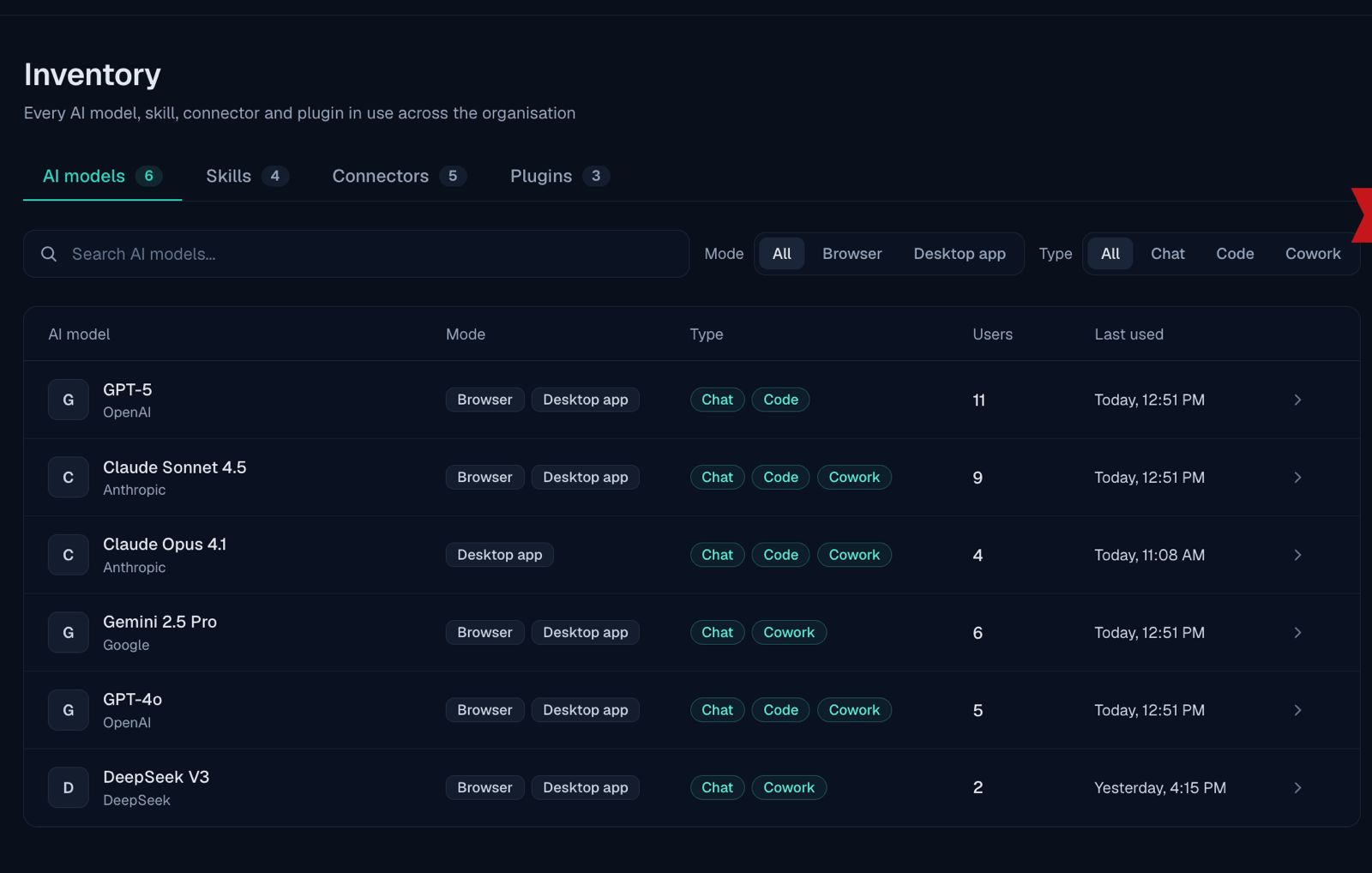
Discover the AI tools, models, and agents being used by your business.
Stay effortlessly compliant with seamless up-to-date AI inventorying.
Trusted By




Regulations expect you to know which AI systems you run. They don't define what an AI inventory should contain or how to build one.
Walled helps teams build an inventory that fills that gap.
Most companies track their AI in a spreadsheet that someone updates when they remember. Walled's AI inventory module is three distinct modules, each built for a specific job: a registry, a bill of materials, and usage telemetry.
A maintained list of every AI system: tools, models, agents, and the MCP servers they connect to. Each entry has an owner and a risk level.
Who It's For
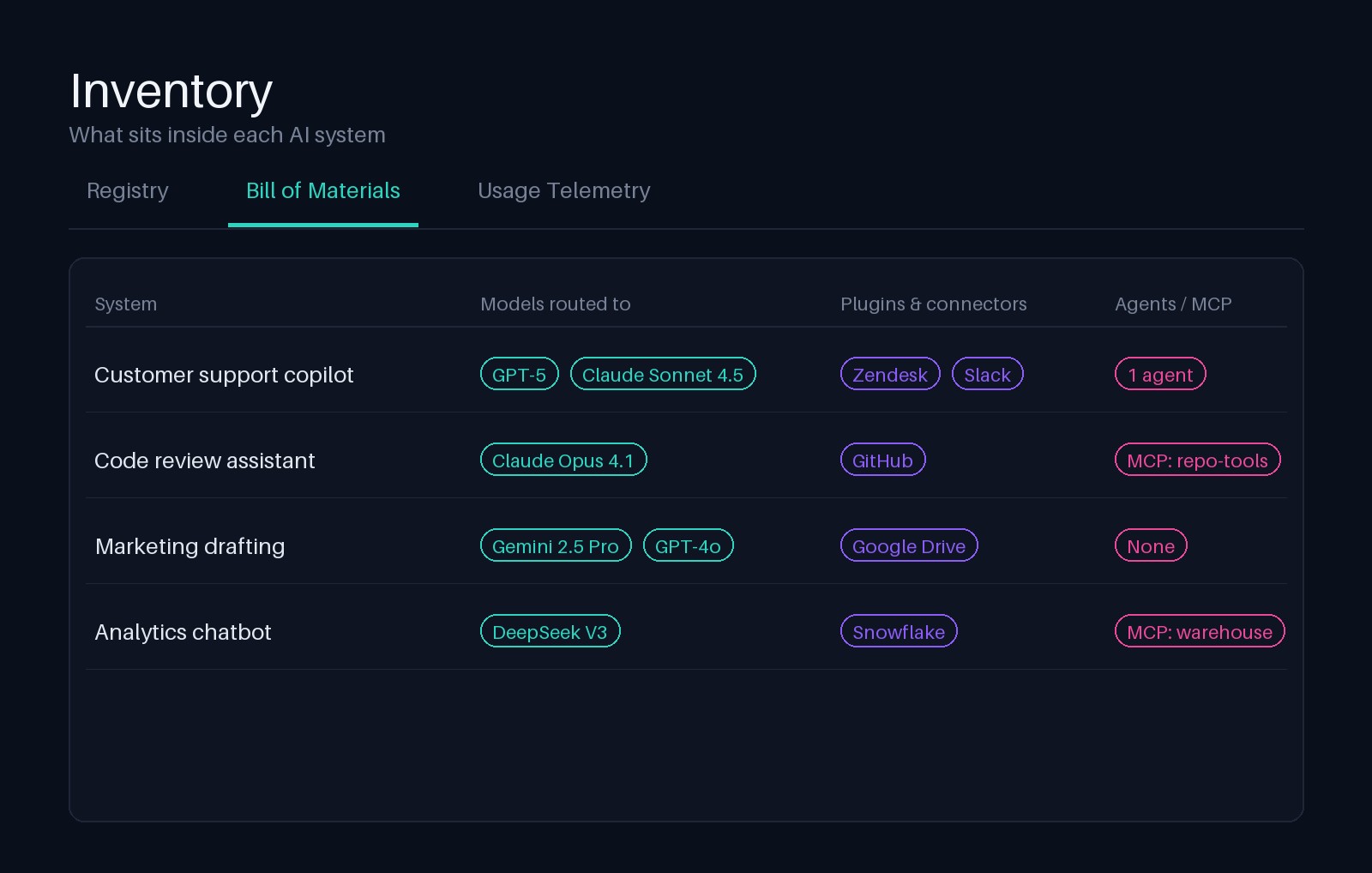
What sits inside each system: the models it routes to, the plugins, connectors, agents, and MCP servers. One approved tool can route to a dozen models, each with different terms.
Who It's For
Evidence that the registry is accurate, showing which systems are used, by whom, and how often. Gain visibility into usage and steer your AI strategy.
Who It's For
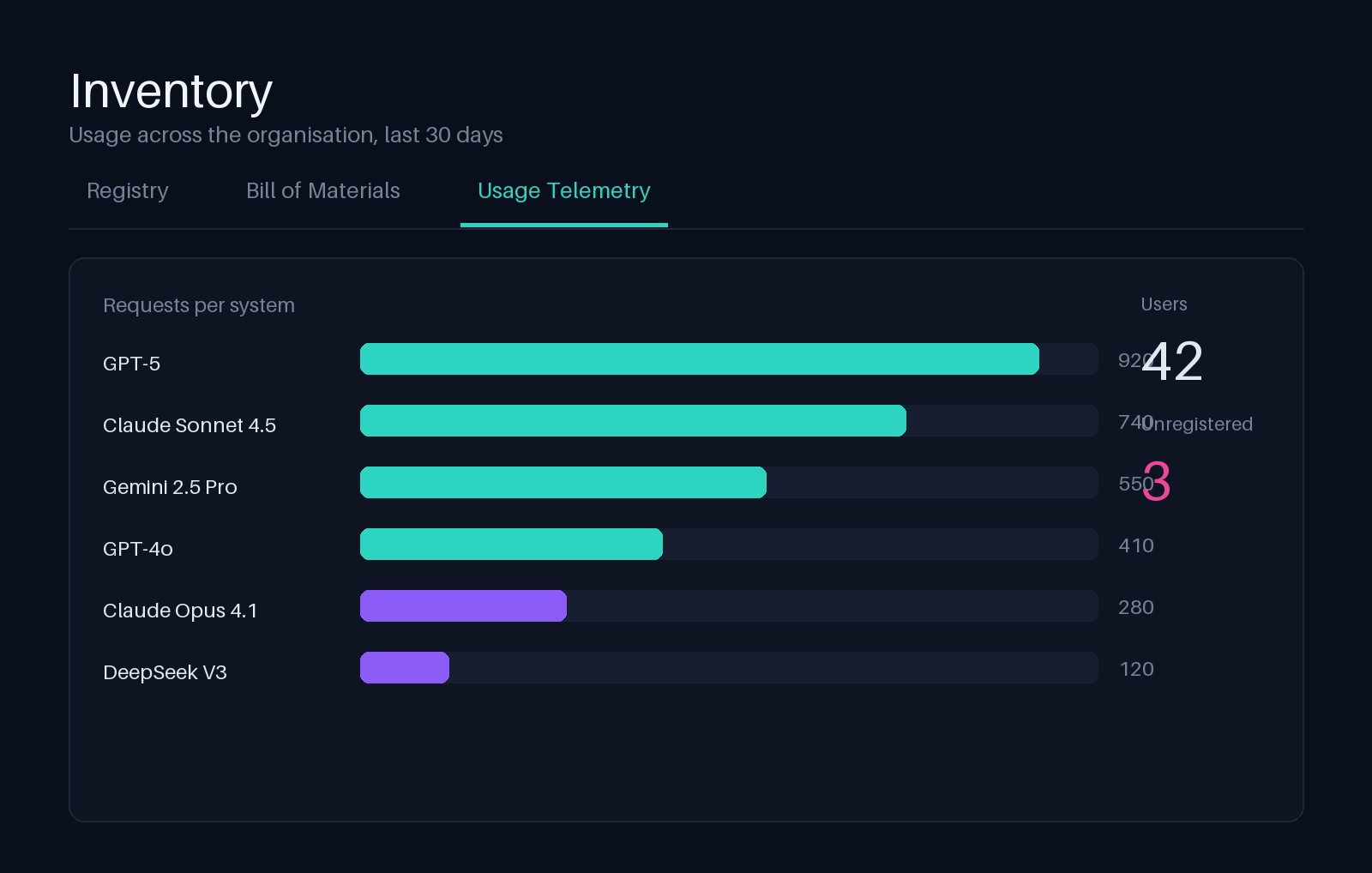
Not all AI is explicitly procured. AI now thrives in browser tabs, desktop apps, plugins, and connectors. WalledAI explores all possible pathways for a comprehensive inventory.
Finds AI tools used in the browser, including those no one declared.
Surfaces AI applications installed on managed endpoints.
Shows which AI providers your traffic and integrations call.
Picks up AI features switched on inside the software you already pay for.
Identifies models, libraries, and AI services in your repositories.
Tracks AI agents and the MCP servers they connect to.
Each inventory entry carries the details that regulators and auditors care about most.
| Section | What it answers |
|---|---|
| Owner | Who is accountable for this system? |
| Data access | What data can this system reach? |
| Training terms | Does the vendor train on your data? |
| Inference location | Where does processing happen? |
| DPA | Is there a data processing agreement in place? |
| Risk level | How much harm could this system cause if it fails? |
Each inventory record feeds the evidence these frameworks ask for, across AI governance, security, and privacy.
AI governance
EU AI Act
Registration fields for high-risk systems.
NIST AI RMF
Inventory of AI systems under GOVERN 1.6.
ISO/IEC 42001
Documented AI system components and resources.
Security
ISO/IEC 27001
Inventory of information and associated assets (Annex A, control 5.9).
SOC 2
Evidence that controls over AI tools are operating.
Privacy
GDPR
Records of processing activities under Article 30.
HIPAA
Risk analysis covering systems that handle ePHI.
PDPA
Accountability for personal data that AI tools process.
Governance needs to see which AI systems are in use, not track every employee. Activity is tied to identity only where a policy requires it.
In the EU, employee monitoring is regulated by several frameworks at once. GDPR Article 88 lets member states set rules for employee data, and monitoring must be necessary, proportionate, and transparent to staff. A data protection impact assessment under GDPR Article 35 is typically required before monitoring starts.
Generate audit trails, compliance reports, board summaries, and evidence packages mapped to your governance policies and regulatory obligations.
Exportable evidence packages
Audit trail extracts
Packaged for reviewers.
Enforcement records
Packaged for reviewers, with the policy decisions behind them.
Compliance reports
Compliance metrics, risk posture, and audit evidence.
Board summaries
Summaries for executive and board review.
WalledAI supports your own audit and attestation work. It does not provide automatic certification or guarantee compliance.
Understand frameworks, regulations, and best practices for enterprise AI governance across all industries.
Why investing in a governance layer delivers 10x returns compared to restricting AI adoption or deploying private LLMs.
As AI agents make autonomous decisions, the data exposure surface grows exponentially. How to protect your organization.
Mask sensitive data across text, images, documents, code, and audio. Protect PII, PHI, financial data, and more before it reaches any AI model.
Screen AI prompts and responses for prompt injection, harmful content, and data leakage with real-time guardrails.
Validate AI responses against ground truth and detect hallucinations before unreliable outputs reach your teams.
Define department-level AI access controls. Control who can use which LLMs and what data they can share.
Automatically classify data sensitivity across all AI interactions. Map to your organization's taxonomy for consistent governance.
Real-time monitoring and compliance reporting across every LLM. Audit logs and policy alerts mapped to regulatory frameworks.
Everything decision-makers, security teams, and auditors ask about AI inventory.
An AI inventory is a maintained register of every AI system your organisation uses or builds, including tools, models, agents, and the MCP servers they connect to.
Discovery looks across browsers, desktops, APIs, SaaS, code, and agents, so AI that was never formally approved still appears in the inventory.
NIST AI RMF expects mechanisms to inventory AI systems, and the EU AI Act sets registration fields for high-risk systems. GDPR Article 30 requires records of processing activities, which AI tools that handle personal data fall under.
At minimum, the owner, data access, training terms, inference location, DPA status, and risk level.
Attribute activity to identity only where policy enforcement or incident response requires it, and aggregate usage by team, tool, and model for cost and reporting.