AI Governance in Financial Services
Securing Smarter Finance
AI is spreading across financial services faster than the controls around it. Client data faces privacy risk, and agents are acting autonomously without a clear audit trail.
WalledAI bridges that gap. We enable all-round AI governance for financial services, including sensitive PII masking, policy enforcement, and agentic AI governance.
AI agents governed
Trusted By





The short answer
What Is AI Governance in Financial Services?
AI governance in financial services is the set of policies, technical controls, and audit records that decide how banks, insurers, and asset managers use AI.
It covers which AI tools are in use, how client data is protected before it reaches a model, who is accountable for each model and agent, and the evidence regulators can review.
Why it matters: regulators expect firms to show how AI decisions are made and controlled. That expectation now covers AI agents that act on accounts and payments, not only models that score or recommend.
Regulations Shaping AI Governance in Finance
AI governance in financial services is now a global obligation. Regulators are not waiting for AI-specific rules. The EU AI Act sets risk-based obligations, and US supervisors expect AI to meet the same model risk standards as any other model.
European Union
EU AI Act
Risk-based obligations. AI used for creditworthiness assessment and credit scoring is classed as high-risk.
The Challenge: AI Adoption vs. Regulatory Reality
Financial institutions are caught between two imperatives: adopt AI to stay competitive, or restrict it to satisfy regulators. Most choose restriction, which pushes AI use out of sight and adds risk. WalledAI removes that false choice.
$6.08M
Average cost of a financial sector data breach
Source: IBM, 2024
55%
Of generative AI users have used unapproved tools at work
Source: Salesforce, 2023 (14,000+ workers)
Shadow AI Is Already Here
Relationship managers, analysts, and compliance officers already use ChatGPT, Claude, and Copilot, with client names, portfolio values, and deal terms in their prompts. Blocking tools does not stop usage. It pushes usage out of sight.
Private LLMs Are a Dead End
A private LLM is expensive, locks you into one model that falls behind within months, and still does not solve the governance problem. Data protection depends on the model's training pipeline, not on your controls.
The Governance Layer Approach
WalledAI sits between your employees and any LLM. Data is masked before it leaves your boundary and unmasked when it returns. The model gets context, not content, so teams get the best AI and your data stays under your control.
Move from Finance AI Governance Policies
to Realtime WalledAI Controls
WalledAI runs six controls across the AI your firm uses, from the first inventory to the evidence an examiner asks for.
- 01
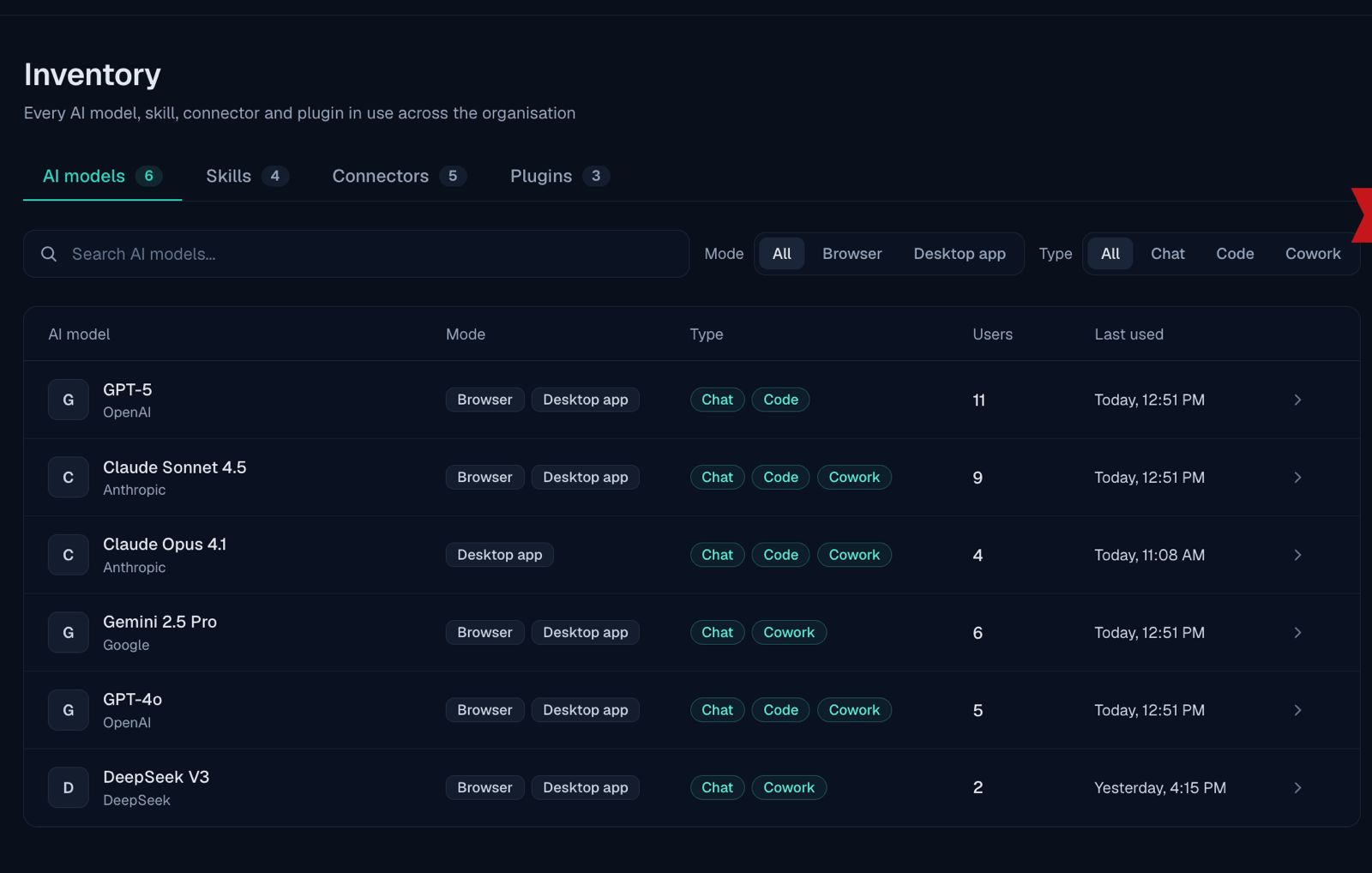
Inventory
Find every AI tool and agent in use, including ones nobody approved, and keep a live inventory of them.
Confidentiality levels
PublicInternalConfidentialRestrictedPortfolio notes for a private banking client
ConfidentialOwner: Wealth ManagementExternal AI model: Blocked
- 03
Define policy
Set rules by team and role, so role-based permissions decide which teams can use which models and tools.
Policy inheritance
Organization AdminGlobal policyNo Restricted data goes to any external LLM.
Department AdminCredit riskLoan-scoring model only. Other models blocked.
Team LeadTrading deskMarket data queries allowed. Competitor strategy blocked.
End UserAnalystApproved models only, with masking applied to every query.
- 04
Detect
Find sensitive data, including PII, before a prompt reaches any AI model.
Before the model sees it
Update the mortgage file for Maria Lopez, account 4471-0023-8891, national ID S7812345D.Sent to the model
Update the mortgage file for [CLIENT_1], account [ACCOUNT_1], national ID [NATIONAL_ID_1]. - 05
Enforce
Walled Correct checks AI responses against your verified sources in real time, blocks or flags the unreliable ones, and protects against a wide variety of LLM attacks.
Query from a relationship manager
"Tell the client this fund guarantees a 12% annual return."Flagged: unsupported guaranteeNo approved source for this claimPolicy violated. Kindly review and rewrite.
Deploy Agentic AI Governance for Financial Services
WalledAI governs AI agents with four controls. Each one maps to a control on the platform.
Step 1
Give each agent its own identity
Use scoped, revocable credentials, not shared service accounts.
Step 3
Keep a kill switch
Stop an agent immediately if it breaks its limits. WalledAI platform provides this protection in real time.
Step 2
Limit what it can reach
Grant least-privilege access to approved tools and data only. WalledAI's RBAC enforces agent-level privileges.
Step 4
Log every action
Tie each agent step to a specific agent, user, and policy. We log every little AI interaction.
Financial AI Governance that Supports Audit Compliance
Examiners test AI models the way they test any model: inventory, validation, traceable decisions, and evidence on request.
Model inventory
Is every AI model in use recorded, with an owner?
AI Inventory and Shadow AI Detection find the AI in use, including tools nobody approved.
Output validation
Are model outputs checked against verified sources?
Walled Correct checks AI responses against your verified sources in real time.
Audit trail
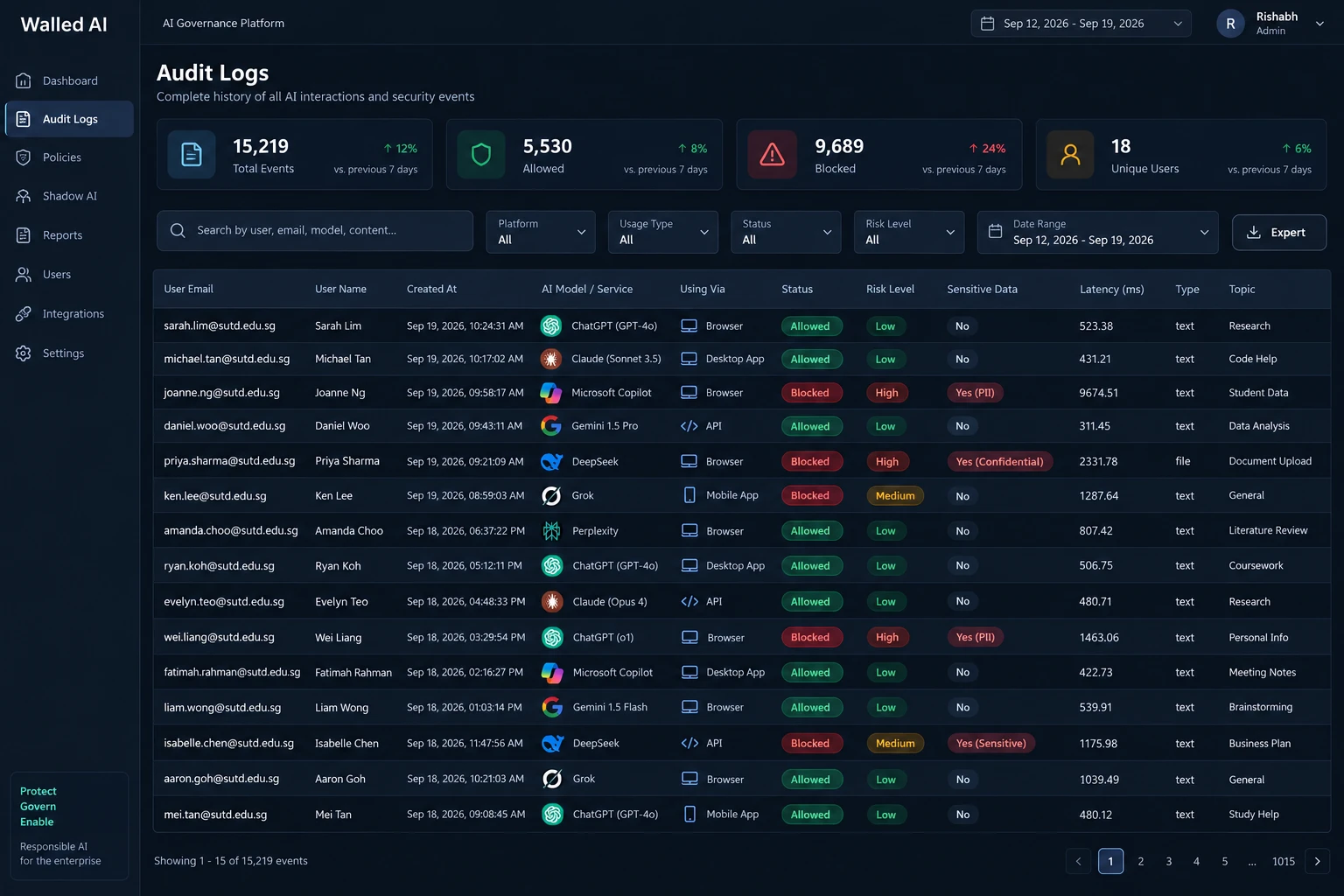
Can each decision be traced to a user, a model, and a policy?
The Governance Dashboard logs each interaction with user, model, access method, and allowed or blocked status.
Evidence on request
Can records be produced for an examiner without rebuilding them?
Evidence packages export for reviewers from the Governance Dashboard.
Ongoing monitoring
Do controls still work after deployment?
Real-time monitoring and compliance reporting across every LLM.
Who Benefits and How
Every stakeholder in a financial institution looks at AI governance through a different lens. Here is what WalledAI means for each.
Chief Information Security Officer (CISO)
The pain: Client PII, trading strategies, and deal pipelines must not leak. Every AI interaction is a potential exfiltration event.
With WalledAI: Every AI interaction is logged and auditable. You see what data was masked, what reached the model, and who initiated it.
Chief Risk Officer (CRO)
The pain: AI adds model, operational, and reputational risk at the same time. You need controls you can measure, not promises.
With WalledAI: User roles map AI permissions to your existing risk taxonomy, with risk profiles per department, use case, and sensitivity level.
Chief Technology Officer (CTO)
The pain: Engineering teams want the best AI tools, but security and compliance reviews slow every new tool down.
With WalledAI: WalledAI is model-agnostic. Approve one governance layer, then let teams use the models you approve, including future ones.
Use Cases Across Financial Services
Every department in a financial institution has its own AI needs and its own data risks. Here is how WalledAI protects each one.
Relationship Managers and Wealth Advisory
A relationship manager drafts a portfolio review letter. Client names and holdings are masked before the draft is generated, and the letter is restored with real details afterwards.
Compliance and Regulatory Reporting
A compliance officer asks about a regulatory requirement. The answer is checked against approved regulatory sources before it is used.
Claims Processing and Underwriting (Insurance)
An underwriter uses AI to summarise medical histories and risk factors. Health data is masked, and the summary is checked before it reaches the underwriting decision.
Retail and Corporate Banking
Branch staff use an AI assistant to answer customer questions about rates and products. Answers are checked against approved product information, and customer data is masked.
Internal Audit and Risk Management
Internal audit uses AI to analyse transaction data for patterns of potential fraud. Access is limited to the auditors on the engagement, and every query is logged for review.
Anti-Money Laundering and Financial Crime
AML analysts use AI to draft suspicious transaction reports. Customer identifiers are masked, and access is limited to the analysts on each case.
Ready to Govern AI in Financial Services?
See how WalledAI helps your bank, insurer, or asset manager find the AI in use, protect client data, and keep audit-ready evidence for regulators.
Learn More about Financial AI Governance
AI Governance in Financial Services: Controls for Banks Using ChatGPT and Copilot
How banks can put controls around the assistants their staff already use.
Regulator-Ready AI Audit Logs: What Enterprises Need to Capture
The log fields examiners ask for, and how to capture them.
MAS TRM Compliance
How WalledAI supports Singapore's technology risk management guidelines for financial institutions.
You May Also Like
AI Agent Governance
→Real-time governance for autonomous agents, with scoped access and full audit logs.
Walled Protect
→Real-time screening of prompts, responses, and agent instructions.
Walled Redact
→Masks sensitive data before it reaches any AI model.
Walled Correct
→Checks AI responses against your verified sources in real time.
Enterprise RBAC
→Role-based permissions that decide which teams can use which models and tools.
Governance Dashboard
→Audit logs, compliance reports, and evidence packages for reviewers.
Frequently Asked Questions
What is AI governance in financial services?
It is the set of policies, technical controls, and audit records that decide how banks, insurers, and asset managers use AI. It covers which AI is in use, how client data is protected, who is accountable, and what evidence regulators can review.
How is AI governance applied in financial services?
It runs as a sequence of controls: inventory the AI in use, classify data, set policy by team and role, detect sensitive data, enforce policy on each interaction, and keep evidence of every decision.
Does AI governance in financial services apply worldwide?
Yes, but the rules differ by region. The EU AI Act sets risk-based obligations, US supervisors apply model risk guidance such as SR 11-7, and Singapore's MAS TRM covers AI use at financial institutions. Firms that operate in several regions need to map each set of rules.
What are the best tools for AI governance in financial services?
The right tool depends on whether you need policy documentation, runtime enforcement, or both. Some tools only document policy. WalledAI also enforces it on each interaction and keeps the audit trail.
Show all FAQsShow fewer questions
How do you govern AI agents in financial services?
Give each agent its own scoped credentials, limit what it can reach, and log every action against a specific agent, user, and policy. WalledAI brings agents under the same controls as the rest of your AI.
What do auditors check for AI governance?
Auditors typically check the inventory of AI models, the validation of model outputs, a traceable audit trail for each decision, and evidence they can review on request.